

 Amazing Race
 Choose Wisely
 Unlock the Box
 Mall Hunters
 Mission Impossible
 The Great Charity Race
 Clues to a Mystery


 Random Acts of Kindness

 Scavenger Hunt From Home
 Where in the World is the Crystal Snow Globe?
 The Big Escape
 Team Trivia
 The Feud
 Summer Olympics
 Winter Olympics
 Who Kidnapped Santa?





“Friendly or Thrilling?” Priya reads the choices. “Friendly sounds sensible.”
Across the table, Daniel objects: “That is exactly what a trap would call itself.”
Nobody has seen the task yet. The negotiation has already started.
Yes—different challenges can still feel like one corporate event. Teams need a shared competitive objective, understood scoring rules, common challenges and a finish that brings their different adventures together. Identical tasks are not the only way to create a shared experience.
Here is a sample indoor plan for 40 colleagues in eight teams of five, using Social Scavenger’s Choose Wisely format. The room-based prompts are customization ideas to discuss when booking. Follow two teams through the same fork, then use the decision table to judge whether this kind of choice suits your gathering.
The choice comes before the task
The Friendly/Thrilling fork comes from Choose Wisely. Its published example reveals a pose challenge or a dance routine after selection, with Thrilling offering up to twice the points. The game combines these branching decisions with challenges shared across teams.
That is surprise-based team choice—not browsing a fully disclosed menu of activities. The labels invite a guess; the reveal supplies the assignment.
For our indoor plan, the opening briefing identifies Thrilling as the greater potential reward without revealing its task. Agree how those stakes will be explained before play. Keep the task surprising, not the competitive rules. The published example’s multiplier is not something to assume for every fork.
Choose Wisely is also offered as an indoor, app-only experience without posters. The indoor app journey delivers challenges, collects photo and video submissions, and tracks points. One teammate can act as app captain; the decisions should still belong to the team.
Two teams, two reveals
Team Compass chooses Friendly
Compass wants an approachable first task. Daniel makes one final argument for Thrilling, but another colleague suggests saving the bigger gamble until they have found their rhythm. Priya checks for other views, then selects Friendly.
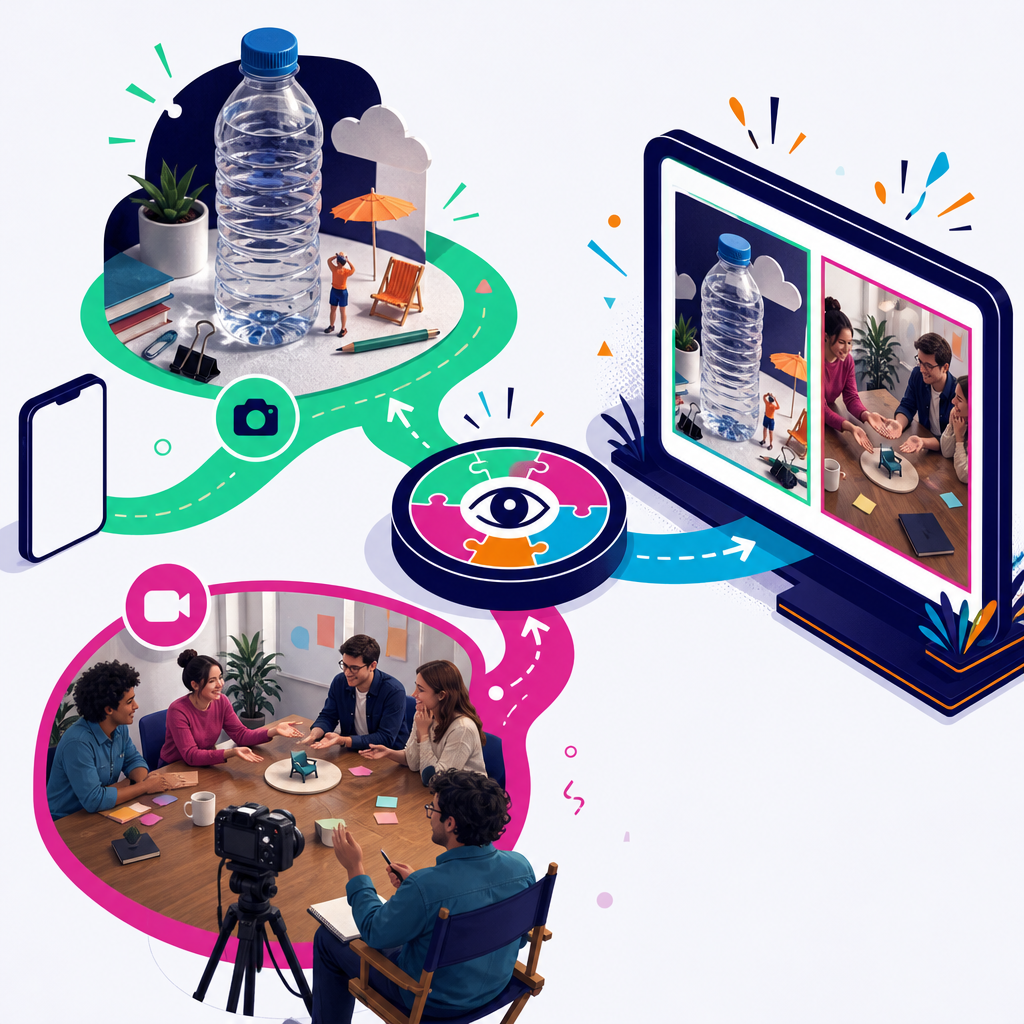
The app reveals a photo challenge: make an ordinary tabletop object look like an enormous landmark. Keep everything on the table—no climbing or moving furniture.
“We’ve chosen architecture,” Daniel announces, inspecting a water bottle.
They place it close to the camera, with tiny objects farther behind. At first, the result looks exactly like a bottle on a table. Priya spots the problem: the visible tabletop edge gives away the scale.
A seated teammate suggests lowering the camera angle and cropping out the bottle’s base. Another shifts a small object into the distance. Suddenly, the bottle looks monumental.
After about six minutes, Compass submits its photograph through the app and continues. The satisfying moment was not taking the picture; it was watching an unconvincing arrangement become an illusion because someone noticed the right detail.
Team Wildcard chooses Thrilling
Wildcard hears “greater point opportunity” and immediately becomes interested. Lena asks whether they are choosing it because it sounds enjoyable or because nobody wants to look cautious.
“Both,” someone admits. They choose Thrilling together.
The app reveals a 15-second, single-take video brief: an invisible miniature visitor interrupts an ordinary meeting. Make the arrival understandable without explaining the joke afterward.
The first plan involves a chase, a rescue and an imaginary helicopter. Lena, who prefers not to appear on camera, cuts it to three readable moments: notice something tiny, make room, applaud its arrival.
A coaster becomes the visitor’s seat. Willing performers lean down to listen, exchange astonished looks, then give the smallest guest an absurdly grand welcome. Lena directs the timing; another teammate points out that everyone must look at the same spot or the visitor appears to be teleporting.
They submit the video after roughly eight minutes. The bigger opportunity has demanded more coordination—not simply a more adventurous label.
Different detours, one shared puzzle
Later, both teams receive the same observation puzzle in the app: identify which of three miniature visitors attended a meeting, using supplied portraits, a scene and clues.
Compass latches onto a matching hat. Wildcard does too. Then each team has to reckon with an awkward detail in a reflection that undermines the obvious answer.
Priya asks Compass to stop defending its first guess and compare the remaining portraits. At Wildcard’s table, the colleague who operated the camera now leads the evidence discussion. Each team submits its answer in the app and continues.
These are selected moments within the wider game, not a compulsory three-round sequence. The teams need not reach the common puzzle simultaneously. What matters is that they now have something recognizable to compare—as well as something the other team never experienced.
A shared scoreboard does not make every path equivalent
Compass spent less time on its creative challenge, leaving more time for later opportunities. Wildcard pursued a larger potential reward. Neither decision guarantees the better final score.
Before booking, settle what earns completion points, what any creative bonuses recognize, and how branch opportunities will be explained. Keep submissions and point tracking in the app, with human creative judging included in the selected support when wanted.
Equal rules, identical tasks and equal scoring opportunities are different promises. A higher possible reward is not a guaranteed award. Nor does access to the same branch labels establish that every participant can meaningfully take either path.
The shared finish does another job that standings cannot. Show Compass’s enormous bottle beside Wildcard’s tiny visitor, then revisit the common puzzle. Compass finally discovers what the other choice produced. Wildcard explains why the helicopter was cut. The room gets to enjoy the paths it did not take.
Would you buy this format for your group?
Separate what teams enjoy from what individuals require. Then consider how seriously the gathering will treat the winner.
| Decision area | Your situation | Verdict | Booking implication |
|---|---|---|---|
| Team preferences | Colleagues enjoy different styles and like negotiating surprises. | Good fit | Keep varied branches and common challenges; invite opinions beyond the app captain’s. |
| Team preferences | Each person wants an independent activity and freedom to come and go. | Poor fit | Choose a format built around individual freedom, not team path decisions. |
| Individual participation | Some colleagues need seated participation or prefer not to appear on camera. | Conditional fit | Review every branch and shared task; agree meaningful participation arrangements. |
| Individual participation | Organizational policy prohibits the proposed recording and sharing. | Do not buy unchanged | Request a separately scoped app-based experience compatible with that policy. |
| Scoring expectations | The group accepts different opportunities and creative judging as friendly competition. | Good fit with clear rules | Explain branch stakes and judging criteria; keep prizes modest. |
| Scoring expectations | A substantial prize requires identical tasks, identical maximum opportunities and an entirely objective winner. | Wrong purchase as proposed | Request a common-challenge format with objective scoring instead. |
| Event support | The organizer wants to play rather than manage the room. | Conditional fit | Assign another coordinator or separately select onsite hosting. |
| Overall decision | Forty colleagues welcome surprise and shared competition, with participation needs resolved. | Proceed to a scoped quote | Request branching, common tasks, explicit scoring and selected support. |
For this plan, request object-only versions of both creative prompts and no bonus merely for showing faces. That arrangement must cover the actual tasks and scoring; the word “Friendly” does not promise it. Object-only filming also remains a media activity, not a camera-free event.
Ask privately about access needs, assess the actual room, plan communication and rest arrangements, and obtain recording permission. These steps follow Government of Canada inclusive-event guidance. Shared devices and backstage roles alone do not resolve every need.
A useful contribution changes what the team submits, rather than giving someone a nominal spectator job. A team vote is not consent, and branching is not a guarantee of accessibility or individual opt-outs.
Book the whole event window—not just the game
For eight teams of five, request this 90-minute participant block. Venue access and setup happen beforehand. Social Scavenger’s indoor guidance describes typical 60- or 90-minute games and other lengths by arrangement; agree how joining and the finish fit your particular booking.
| Elapsed time | What happens |
|---|---|
| 0–10 minutes | Join, check devices, and brief participation arrangements and scoring. |
| 10–70 minutes | Play branching and shared challenges. |
| 70–90 minutes | Regather, enjoy selected submissions, revisit the common puzzle and reveal results. |
Use comfortable team bases, clear circulation and a quieter place for video. App captains should make prompts available to teammates in the agreed accessible way before anyone submits. Appoint a non-playing room coordinator in addition to the 40 players to lead the welcome, handle local needs and bring everyone back.
Choose support for the experience you want
- Classic: The indoor package listing includes producer preparation, a private game, submission stream, results, slideshow and content export. Do not assume live creative judging or an onsite host.
- Premier: The detailed indoor description adds a virtual event team, messaging, creative bonus points and a custom event video. This is the relevant starting point for our sample’s live support and judging. Agree video delivery timing separately from the live finish.
- Onsite hosting: This is distinct from remote game-day support. Our plan uses an internal coordinator; a remote judge cannot physically manage the room.
Social Scavenger offers customization of existing games, so the sample prompts need not imply a ground-up build. Keep that creative scope separately identified in the quote, alongside support and media deliverables.
A booking brief that protects the surprise
We’re planning an indoor event for 40 colleagues at [venue] on [date], in eight teams of five. Please quote Choose Wisely for a requested 90-minute participant window: 10 minutes joining and briefing, 60 minutes gameplay and 20 minutes for the shared finish.
We want branching decisions and common challenges, with point opportunities explained before choices and task reveals kept surprising. Please review all challenge demands: seated participation, meaningful off-camera contributions, object-only creative options and no required physical exertion or performance by every individual. We will share access needs privately. Explain how these arrangements affect scoring.
Quote Premier remote support, creative judging and an event video, with customization charges and media delivery timing identified separately. We will supply a non-playing room coordinator. Please agree setup, connectivity, display arrangements, who leads the finish, submission visibility and later sharing. Flag requirements this plan cannot meet; list any onsite host or expanded media package separately.
Buy branching when deciding together is part of the pleasure. Keep the uncertainty inside the adventure—not in participation requirements or the rules for winning.