


 Amazing Race
 Choose Wisely
 Unlock the Box
 Mall Hunters
 Mission Impossible
 The Great Charity Race
 Clues to a Mystery


 Random Acts of Kindness

 Where in the World is the Crystal Snow Globe?
 The Big Escape
 Team Trivia
 The Feud
 Summer Olympics
 Winter Olympics
 Who Kidnapped Santa?





Corporate team building events: start with your people and purpose
The challenge with corporate team building events is choosing something colleagues can participate in without giving the organizer a second job. Social Scavenger offers city, at-your-venue, and virtual game formats. An organized game is worth considering when you want an existing activity rather than designing every challenge yourself; DIY may suit a straightforward activity you have the time and skills to run.
A corporate team building event is a planned shared activity for coworkers with an explicit connection, collaboration, or celebration goal. That might mean welcoming new hires, bringing departments together at a company gathering, or giving distributed colleagues a shared experience beyond their usual meetings.
Start with the people and purpose, then compare formats, participation requirements, and planning responsibilities. This guide helps you make those decisions without treating one afternoon as a guaranteed culture transformation.
What do you want your corporate team building event to accomplish?
Welcome new hires, connect departments, or celebrate a shared milestone
Write a one-sentence brief before looking at activities. Different goals call for different experiences:
- Onboarding: give new colleagues a manageable way to meet people and contribute without needing company history or inside jokes.
- Cross-department connection: create small-group tasks that encourage coworkers outside their usual work circles to exchange ideas.
- Celebration: acknowledge a shared milestone with an activity that leaves room to enjoy one another’s company.
- Distributed-team connection: choose a format remote colleagues can participate in directly, rather than watch from a screen in a conference room.
Choose an observable goal rather than promising a culture transformation
“Give colleagues a chance to solve a problem with someone from another department” is more useful than “fix collaboration.” You can design for the first goal and ask participants whether it happened.
The Canadian Centre for Occupational Health and Safety includes volunteering days, problem-solving games, and other team-building activities among ways to support social connections. Treat an event as one part of a supportive workplace—not a substitute for manageable workloads, respectful management, or clear responsibilities.
Corporate team building event ideas by format
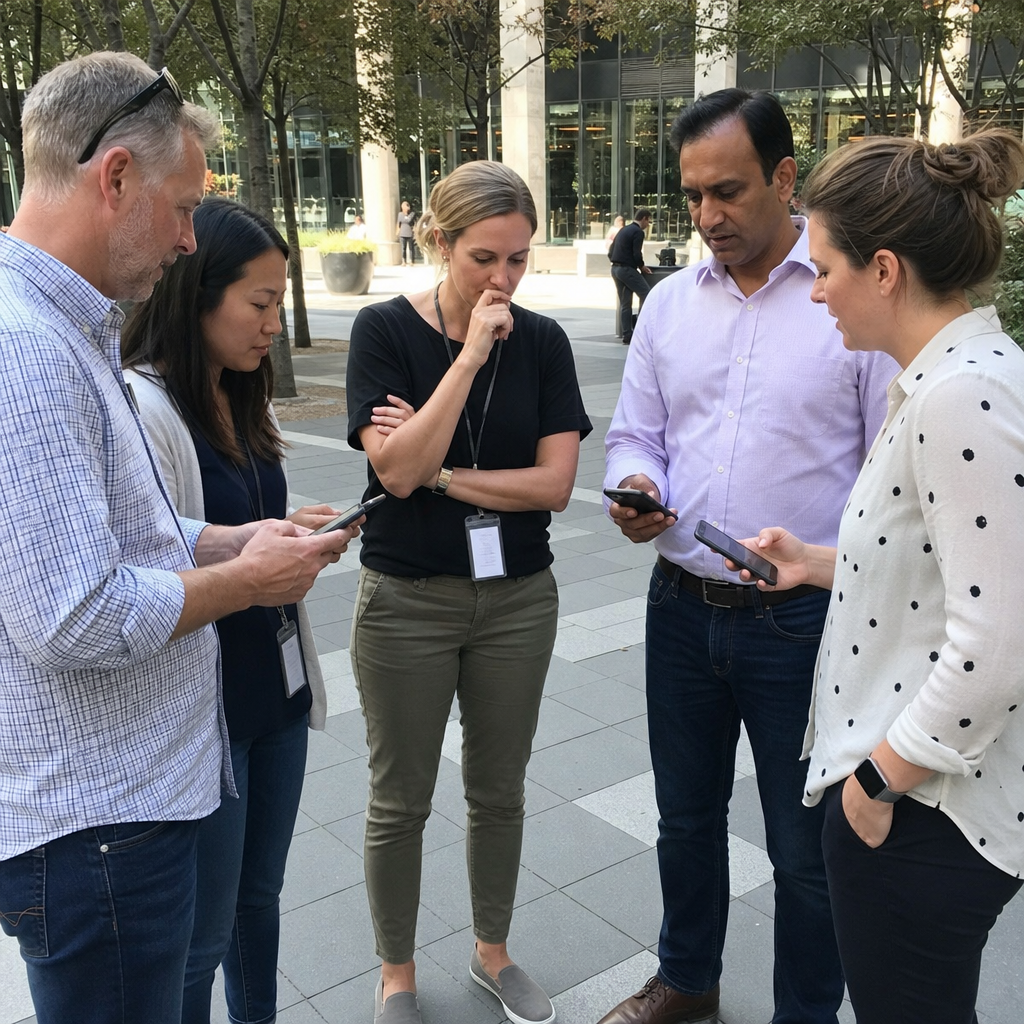
City scavenger hunts for an off-site shared challenge
Social Scavenger’s city scavenger hunts are an option for planners considering an off-site game. Its Ultimate City Scavenger Hunt has 45+ challenges in a walkable area. That description applies to the named game, not necessarily every city format.
- Intended goal: give coworkers a shared challenge outside their normal workplace routines.
- What colleagues do together: tackle challenges as a group and discuss how to approach them.
- Organizer responsibilities: confirm local availability, attendance arrangements, meeting points, transportation, and the division of event-day responsibilities.
- Participation considerations: check the actual route, surfaces, distances, seating, and restroom access. A walkable area is not automatically accessible to every participant. Ask about weather arrangements and participation alternatives before booking.
Interactive poster games at your venue
If your company gathering already has a venue, interactive poster games offer a format to explore without adding a separate city outing. Social Scavenger prints and ships interactive posters. Teams uncover hidden clues, solve puzzles, and take on creative photo, video, and AI challenges before a leaderboard and slideshow reveal.
- Intended goal: create a shared activity within an office gathering, retreat, or other workplace event.
- What colleagues do together: interpret clues, compare puzzle ideas, and collaborate on creative challenges.
- Organizer responsibilities: confirm shipping timing, venue permissions, poster placement, setup, technology, and who runs the activity and reveal. Do not assume installation or an on-site host is included.
- Participation considerations: assess poster readability, reach, circulation space, and seating. Ask how photo, video, and AI submissions are used and whether suitable participation alternatives are available.
Virtual mysteries, game shows, and creative challenges
Social Scavenger’s live-hosted virtual team building games include mysteries, game shows, and creative challenges on Zoom, Teams, or Google Meet. Hosting is provided, which can let the internal organizer play rather than lead the game.
- Intended goal: give distributed coworkers a shared experience they can join from their own locations.
- What colleagues do together: participate in a hosted mystery, game show, or creative challenge.
- Organizer responsibilities: coordinate time zones, invitations, internal platform permissions, and a technology rehearsal; confirm the attendance arrangements and game duration.
- Participation considerations: ask about captions, accessible materials, camera expectations, audio requirements, and alternative ways to contribute. Platform availability alone does not establish that every accommodation is included.
Cooking classes and creative workshops
A cooking class or creative workshop can suit a team that would rather make something together than compete. These are generic activity options, not Social Scavenger offerings.
- Intended goal: encourage conversation around a shared task or mark a team milestone.
- What colleagues do together: prepare a dish, create a shared piece, or exchange ideas while working on individual projects.
- Organizer responsibilities: arrange instruction, materials, workspace, cleanup, and any food service.
- Participation considerations: check allergies, dietary needs, tool use, seating, sensory conditions, and whether tasks require prolonged standing. Avoid making alcohol central to participation.
Escape rooms and collaborative puzzle sessions
- Intended goal: give colleagues a bounded problem that invites different ideas and approaches.
- What colleagues do together: examine clues, test possible solutions, and share discoveries.
- Organizer responsibilities: confirm capacity and timing for an escape room, or design and test the materials for a DIY puzzle session. Plan how multiple groups will participate without long waits.
- Participation considerations: check lighting, sound, room access, exit arrangements, and time-pressure preferences. A seated puzzle session may be worth comparing with an immersive room, but assess its materials too.
Volunteer shifts and community projects
- Intended goal: work together on a useful task requested by a community organization.
- What colleagues do together: complete agreed work such as sorting supplies, assembling materials, or helping with a suitable project.
- Organizer responsibilities: confirm that the organization wants group support, clarify supervision and training, and arrange transportation and supplies as needed.
- Participation considerations: check physical demands, safety requirements, scheduling, and whether employees have a comfortable alternative. Do not assume every cause or task suits every colleague.
How to choose the right event for your team
Compare location, group logistics, participation needs, and planning effort
Use the same fields for each shortlisted format. These compact comparisons help separate the activity’s appeal from the work needed to deliver it:
- Format: city scavenger hunt. Intended goal: off-site connection. Location: a confirmed city area. Organizer tasks: coordinate travel and meeting points. Questions to confirm: route suitability, weather arrangements, staffing, and group logistics?
- Format: interactive poster game. Intended goal: shared challenges at a gathering. Location: your venue. Organizer tasks: coordinate delivery, space, and setup responsibilities. Questions to confirm: placement, technology, facilitation, and reveal arrangements?
- Format: live-hosted virtual game. Intended goal: distributed-team connection. Location: online. Organizer tasks: coordinate schedules, invitations, and access checks. Questions to confirm: platform setup, attendance, duration, and accommodations?
- Format: cooking class or workshop. Intended goal: conversation through making. Location: a suitable workspace. Organizer tasks: arrange instruction and materials. Questions to confirm: dietary needs, task accessibility, capacity, and cleanup?
- Format: escape room or puzzle session. Intended goal: shared problem-solving. Location: a suitable room or workplace. Organizer tasks: manage bookings or create materials. Questions to confirm: simultaneous participation, sensory conditions, and accessible clues?
- Format: volunteer project. Intended goal: shared community contribution. Location: an agreed project site. Organizer tasks: coordinate useful work and supervision. Questions to confirm: training, safety, physical demands, and alternatives?
Build accessibility and employee preferences into the shortlist
Ask privately about participation needs before choosing the format. A short preference check can ask about indoor versus outdoor activities, comfort with competition, travel constraints, and ways people prefer to contribute. Avoid asking employees to disclose diagnoses or explain personal circumstances to the group.
Government of Canada inclusive-event guidance recommends budgeting for accommodations and checking venues directly rather than relying only on an accessibility label. Apply that planning approach to entrances, restrooms, transportation, seating, dietary arrangements, and activity materials.
Where possible, schedule during normal working hours, avoid compulsory personal disclosures, and choose activities that permit different contribution roles. For remote participation, prepare accessible invitations and materials, establish a way to request accommodations, arrange captions where needed, and rehearse the technology. Confirm which arrangements your organization owns and which a provider can support.
A practical corporate team building event planning checklist
Set the budget, assign responsibilities, and confirm what is included
Compare total event costs, not just activity fees. Your working budget should include:
- Activity or provider fees and any applicable taxes.
- Venue, transportation, food, and beverages.
- Materials, equipment, and shipping where applicable.
- Accessibility arrangements and participation alternatives.
- Organizer time for preparation, communications, delivery, and follow-up.
Confirm whether a quote is in USD or CAD and ask what is included, optional, or excluded. Assign an internal decision-maker and an event-day contact. For a Social Scavenger poster game, clarify setup and facilitation alongside the confirmed printing and shipping. For a virtual game, clarify internal coordination alongside the confirmed live hosting.
Plan communications, transportation, technology, and contingencies
- Send a clear invitation: explain the purpose, location or joining method, schedule, expected activity, and private accommodation contact.
- Check travel: assess arrival routes, transportation needs, parking where relevant, and the time required to return to work.
- Confirm technology: ask what equipment, connectivity, and permissions the chosen activity requires rather than assuming.
- Prepare contingencies: agree on weather decisions, technical problems, attendance changes, cancellation terms, and who communicates updates.
- Clarify media expectations: explain any photo or video participation and confirm how submissions will be used.
Build an agenda with a briefing, shared activity, and short debrief
Use this proposed structure as a planning starting point, not as a Social Scavenger event itinerary:
- Briefing: explain the purpose, instructions, participation options, and where to get help.
- Shared activity: leave enough time for instructions, transitions, breaks, and the activity itself.
- Short debrief: ask what helped the group communicate and one thing participants would try in everyday work.
Confirm the activity’s actual duration before setting calendar holds. Protect time for arrivals and departures instead of fitting the game into every available minute.
How to evaluate the event without overstating its impact
Ask about participation, useful interactions, and accessibility
A short post-event pulse check is usually more actionable than a broad question about whether everyone had fun. Ask:
- Could you participate comfortably in the activity?
- Did you interact with someone outside your usual work circle?
- What helped you contribute, and what made it harder?
- What should we change for the next event?
Treat these responses as event feedback—not proof of productivity gains or financial ROI. A 2017 meta-analysis of controlled teamwork interventions found positive effects on teamwork and performance, but structured interventions are not interchangeable with recreational outings. The findings do not establish outcomes for every corporate event or any Social Scavenger product.
Choose one follow-up action for everyday teamwork
Turn a useful observation into a small experiment. If groups benefited from hearing several ideas before choosing a solution, try that approach in a project meeting. Keep the follow-up specific and modest; employees should not have to turn every enjoyable activity into a performance exercise.
DIY vs. organized corporate team building events with Social Scavenger
DIY: take ownership of activity design, materials, instructions, and coordination
DIY works best when the activity is simple, someone has protected planning time, and you can test it before the event. The organizer owns the concept, challenge writing, materials, instructions, facilitation, troubleshooting, participation arrangements, and wrap-up. A colleague running the session may have less opportunity to join it.
Before choosing DIY to save money, include that preparation and delivery time in the comparison. A self-run activity is not automatically the lower-effort option.
Social Scavenger: compare city, poster, and live-hosted virtual formats
Compare the work you need help with against the confirmed provisions of each format:
- For an off-site game: explore city scavenger hunts. The Ultimate City Scavenger Hunt offers 45+ challenges in a walkable area. Ask which local logistics and event-day tasks remain with your team.
- For an activity at your venue: explore interactive poster games. Social Scavenger prints and ships the posters, so your team does not need to produce those materials from scratch. Confirm installation, facilitation, technology, and reveal responsibilities separately.
- For distributed colleagues: explore live-hosted virtual team building games. Hosting is provided for mysteries, game shows, and creative challenges on Zoom, Teams, or Google Meet. Your team should still coordinate invitations, schedules, permissions, and accommodation requests.
The useful distinction is not simply “DIY versus done for you.” It is which design, material-production, and facilitation tasks are covered—and which still need an internal owner. Poster printing and shipping do not establish on-site staffing, and virtual hosting should not be assumed across other formats.
Confirm responsibilities and request a consultation
To discuss your team building event, share your group size, location, and goals. Add your preferred date, budget constraints, and participation requirements so you can ask focused questions about fit. Confirm availability, pricing, duration, inclusions, and the division of responsibilities before committing.
Corporate team building events FAQ
What are good corporate team building events for different workplace goals?
For onboarding, look for approachable shared tasks that do not require company knowledge. For cross-department connection, consider scavenger hunts or collaborative puzzles. For celebrations, workshops or at-your-venue games may suit the gathering. For distributed teams, compare live-hosted virtual options. Use employee preferences and participation needs to narrow the shortlist.
How much should we budget?
Build a total budget covering activity fees, venue, travel, food, materials, shipping where applicable, accommodations, and organizer time. Request a quote for the actual group and format, confirm USD or CAD, and compare inclusions rather than headline prices alone.
How long should the event last?
Work backward from the time colleagues can realistically participate during the workday. Allow for a briefing, the activity, transitions, breaks, and a short debrief. Confirm the chosen game or provider’s duration before publishing the agenda; there is no single length that suits every format.
How can we include remote colleagues and different participation needs?
Choose a format remote colleagues can join directly, ask privately about participation needs, and check materials, captions, technology, and contribution options early. Social Scavenger offers live-hosted virtual games, but specific accommodations require confirmation. Do not assume a video connection makes an in-person activity equally participatory.
How far ahead should we plan?
Start once you have a likely date, group size, location, and purpose. Allow additional preparation for venue bookings, travel, accommodations, internal approvals, and shipped materials. Ask providers about availability and deadlines rather than relying on a universal booking window.