


 Amazing Race
 Choose Wisely
 Unlock the Box
 Mall Hunters
 Mission Impossible
 The Great Charity Race
 Clues to a Mystery


 Random Acts of Kindness

 Scavenger Hunt From Home
 Where in the World is the Crystal Snow Globe?
 The Big Escape
 Team Trivia
 The Feud
 Summer Olympics
 Winter Olympics
 Who Kidnapped Santa?





“Hang on. The winner started on the eighth floor.”
Someone has already begun composing the victory announcement. Now everyone rereads the journey notes. Eighteen seconds still beats twenty-five—but perhaps not when one elevator traveled only a third of the distance. The trophy suddenly needs a much longer label.
That satisfying reversal drives these two critical thinking team building activities for adults. Here are sample experiences, using fictional evidence, for a custom Social Scavenger app-based event:
- The Fastest Elevator Contest: compare impressive numbers before awarding a hotel’s surprisingly contentious trophy.
- The Cancelled Encore: trace three festival reports before publishing an explanation that might have only one source.
Teams receive evidence in the app, discuss interpretations and submit a justified conclusion plus the next useful evidence before continuing. Social Scavenger supports free-form text submissions; one compact response can contain Conclusion / Because / Next useful evidence.
Choose elevators for a conversation about performance comparisons, the encore for source-checking, or both for a short retreat session. Neither requires specialist knowledge, physical challenges or compulsory performance.
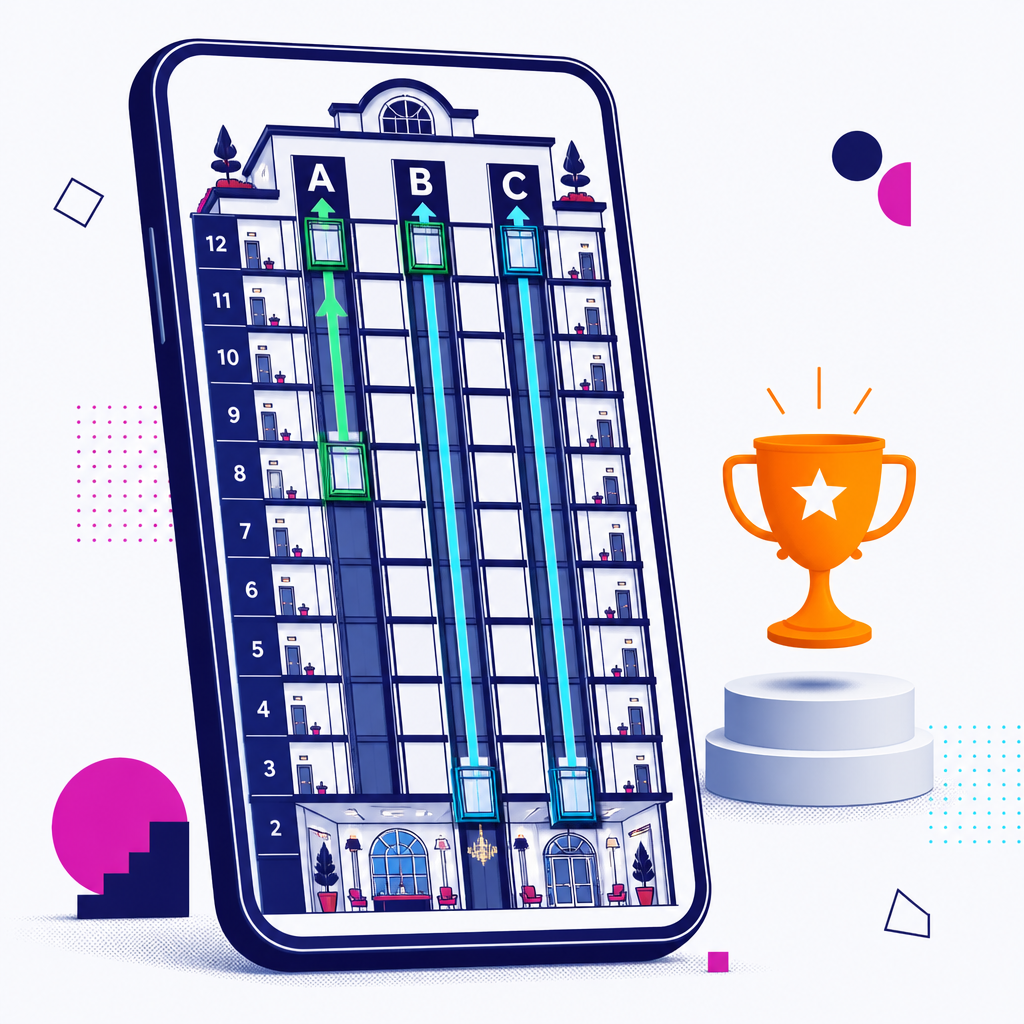
The Fastest Elevator Contest: hold the trophy
Allow ten minutes for this case and its follow-up. The first app challenge gives teams an apparently easy decision:
The hotel wants to award its Fastest Elevator trophy. Which entry deserves it, if any? Explain what these records support and identify the evidence you would request next.
The claims and measurement notes appear together in readable text:
Elevator A: “Top-floor trip: 18 seconds. Fastest ride in the building.”
Floor 8 to floor 12; empty cabin. Timing began when the doors finished closing and ended when they started opening.
Elevator B: “Top-floor trip: 25 seconds. Fastest door-to-door.”
Lobby to floor 12; four passengers; no intermediate stops. Timing began when the doors started closing and ended when they were fully open.
Elevator C: “Top-floor trip: 45 seconds. Fastest lobby-to-rooftop.”
Lobby to floor 12; two passengers; one stop at floor 6. Timing began when the call button was pressed and ended when the doors were fully open at the destination.
One teammate champions A. Another notices its shorter route. Someone checking the timing notes realizes that C’s result includes waiting for the elevator. The discussion stops being arithmetic and becomes a negotiation over what the trophy should actually mean.
Compare these submissions:
- Too certain: “A wins because 18 seconds is the lowest time.”
- Too vague: “There isn’t enough evidence.”
- Better supported: “A has the shortest recorded interval, but these are different journeys measured differently. A starts on floor 8; the others start in the lobby. The timing boundaries, passenger loads and stops also differ. Request repeated trips over the same route, with the same load, stop policy and timing rule.”
The stronger response does not accuse anyone of falsifying a number. It explains why the ranking outruns the records. That distinction reflects NIST’s comparison guidance: conditions other than the factor being investigated can affect a measurement.
Teams submit their ruling and evidence request. The trophy stays unawarded—for now.
The Cancelled Encore: count sources, not headlines
Allow twelve minutes, including the follow-up. Teams become a festival’s update desk, deciding whether they can publish: “Backstage argument caused the cancelled encore.”
The app supplies three reports and their source notes:
Festival fan feed, 10:04 p.m.: “An argument backstage appears to have ended hopes of an encore. Attendee Rowan reported raised voices near the production cabins.”
Local entertainment update, 10:08 p.m.: “Backstage row ends encore, according to the festival fan feed.”
Attendee roundup, 10:12 p.m.: “A nearby festivalgoer described a heated exchange before the missing encore. Source: Rowan’s east-gate post.”
Alongside them sits the original account:
Rowan, 10:01 p.m.: “I was by the east gate around 9:58. Heard raised voices near the production cabins, but couldn’t see who was speaking. Left before the scheduled encore. Maybe there was an argument?”
A teammate starts counting confirmations. Another follows the attribution instead: report two relies on report one; reports one and three rely on Rowan. Three confident voices have become one person by a gate, wondering what they heard.
The team must submit its publication decision, justification and next evidence request:
- Too certain: “Three reports confirm that an argument caused the cancellation.”
- An unsupported reversal: “They all copied one person, so the story is false.”
- Better supported: “The reports trace to one attendee who could not see the speakers and left before the planned encore. They do not independently confirm an argument or establish that it caused the cancellation. Request the show’s cancellation record and the decision-maker’s account.”
The explanation remains possible, not established—and not disproven. As the British Council’s source-checking material explains, reports repeating an original account can create the appearance of independent confirmation.
The challenge is to improve the announcement, not expose a liar. A colleague who trims an unjustified phrase can change the whole team’s submission without delivering a newsroom monologue.
Reopen both files: one winner, one unanswered question
Each experience continues with a separate app challenge containing new evidence. This is where automatic doubt stops being a useful strategy.
The elevator comparison now supports a winner
The follow-up supplies this comparison log:
All three elevators traveled from the lobby to floor 12 with the same four passengers and no intermediate stops. Timing ran from doors fully closed to doors starting to open.
Trial 1: A, 29 seconds; B, 23 seconds; C, 32 seconds.
Trial 2: A, 30 seconds; B, 24 seconds; C, 33 seconds.
Trial 3: A, 31 seconds; B, 25 seconds; C, 34 seconds.
Teams submit a new ruling. A supported response is:
B recorded the shortest travel time in all three comparable trials. Award it the trophy for this tested route and these conditions—not for shortest waiting time or fastest service at every hour. For a busy-period service claim, next request matched busy-period records.
“We can never know” is weaker than that answer. Someone can suggest engraving “Fastest Under These Conditions” on the trophy. The wording is less glamorous; the winner is now defensible.
The stage log confirms less than the headline claimed
The festival’s next app challenge supplies:
Stage manager’s close-of-show log, 9:59 p.m.: “Main set completed. Planned encore not performed. Reason not entered.”
Teams write a concise update and name the next useful evidence:
The planned encore did not take place, according to the stage log. The supplied reports do not establish why; their argument story traces to one attendee who could not see the speakers. Next, request the producer’s contemporaneous cancellation instruction and its stated reason.
The team can commit to what happened while leaving the cause unresolved. Its headline might become: “Planned encore not performed; reason unconfirmed.” All announcements and evidence requests remain submissions inside the game.
A short session with room to reconsider
For this sample plan, start with teams of three to five. Let colleagues contribute by checking comparisons, following sources, questioning an interpretation or drafting the app response. Give everyone a quiet reading pause before discussion; nobody needs to report back publicly.
| Session | Total | Allocation |
|---|---|---|
| Elevator | 20 minutes | 3 introduction; 10 case and follow-up; 2 compare responses; 5 debrief |
| Encore | 22 minutes | 3 introduction; 12 case and follow-up; 2 compare responses; 5 debrief |
| Both | 35 minutes | 4 introduction; 10 elevator; 12 encore; 4 compare responses; 5 debrief |
Keep setup and troubleshooting outside these blocks. Compare selected responses rather than scheduling a presentation from every team, and extend reading time where needed.
Make the evidence accessible, not hidden. Use short text blocks, consistent labels and clearly separated instructions. Attribution should be as readable as the headline—not buried in tiny screenshots. These choices follow W3C guidance on understandable content.
Keep the activity seated and camera-free. Read excerpts aloud when helpful while preserving access to the written material. For a hybrid session, arrange equal access to evidence and discussion for remote teammates. Ask about access needs privately and agree suitable devices, text presentation, assistive-technology arrangements and team-response entry with the producer.
If you include competition, reward the submitted reasoning. Social Scavenger’s platform supports submission judging and scoring. Request human-reviewed in-app credit for accurate evidence use, conclusions that stay within the evidence and specific next-evidence requests. Agree reviewer coverage and when scores will be ready.
Neither certainty nor uncertainty deserves points by itself. “Get more information” is not equivalent to naming a record that would resolve a particular question. Keep recognition about the work—not response length, speaking confidence, skepticism or employee intelligence.
Finish with the detail that changed the decision
Use the final five minutes for three questions:
- Which detail changed our conclusion?
- What did we have enough evidence to say—and what remained possible?
- Which next source or comparison would actually help?
Choose one work-relevant habit to try, such as naming the original source and the limits of a claim before forwarding it. Keep the discussion about decisions, not which colleague was quickest to spot the problem.
To brief the session, adapt this message:
We’re planning a [date] event for [headcount] colleagues in [venue or remote setting], with [available time] and [budget]. We’d like a custom app-based session using [The Fastest Elevator Contest / The Cancelled Encore / both] from this article, including its supplied evidence and follow-up records.
Teams should discuss interpretations, submit a justified conclusion and identify the next useful evidence before continuing. Please scope content design, digital delivery, device and access arrangements, facilitation, human review if we include points, and a five-minute debrief. We will provide participant requirements and approve the final agenda. Please identify who owns each delivery responsibility.
We want recognition of reasoning in the submitted work—not speed or employee ability.
The satisfying finish is a named winner where the records support one—and a better question where they don’t.