
 Amazing Race
 Choose Wisely
 Unlock the Box
 Mall Hunters
 Mission Impossible
 The Great Charity Race
 Clues to a Mystery


 Random Acts of Kindness

 Scavenger Hunt From Home
 Where in the World is the Crystal Snow Globe?
 The Big Escape
 Team Trivia
 The Feud
 Summer Olympics
 Winter Olympics
 Who Kidnapped Santa?




“The marching band is essential,” someone insists. “Finding two matching socks deserves a proper parade.”
The team has just submitted its wonderfully excessive festival plan when the next app challenge appears: the courtyard is unavailable. Everything must fit around three tables. Someone proposes canceling the parade. Someone else proposes a much smaller marching band.
That is the invitation behind these fun team building exercises: make something worth keeping, then reinterpret it under a new brief. The first attempt is not a trap. The second is another creative opportunity.
Here are two sample plans for a custom Social Scavenger session. Choose Festival Flip for playful planning without performance, or Trailer, Take Two for storytelling through video or a written storyboard. Keep the same teammates together across both rounds. Plan on four to six colleagues per team and about 25 minutes for one exercise, after app access is ready.
Social Scavenger supports free-form text and video challenges. Use a separate challenge for each round, keeping both submissions rather than replacing the first. Its custom-game options include scheduled challenge availability, making the changed brief part of the experience.
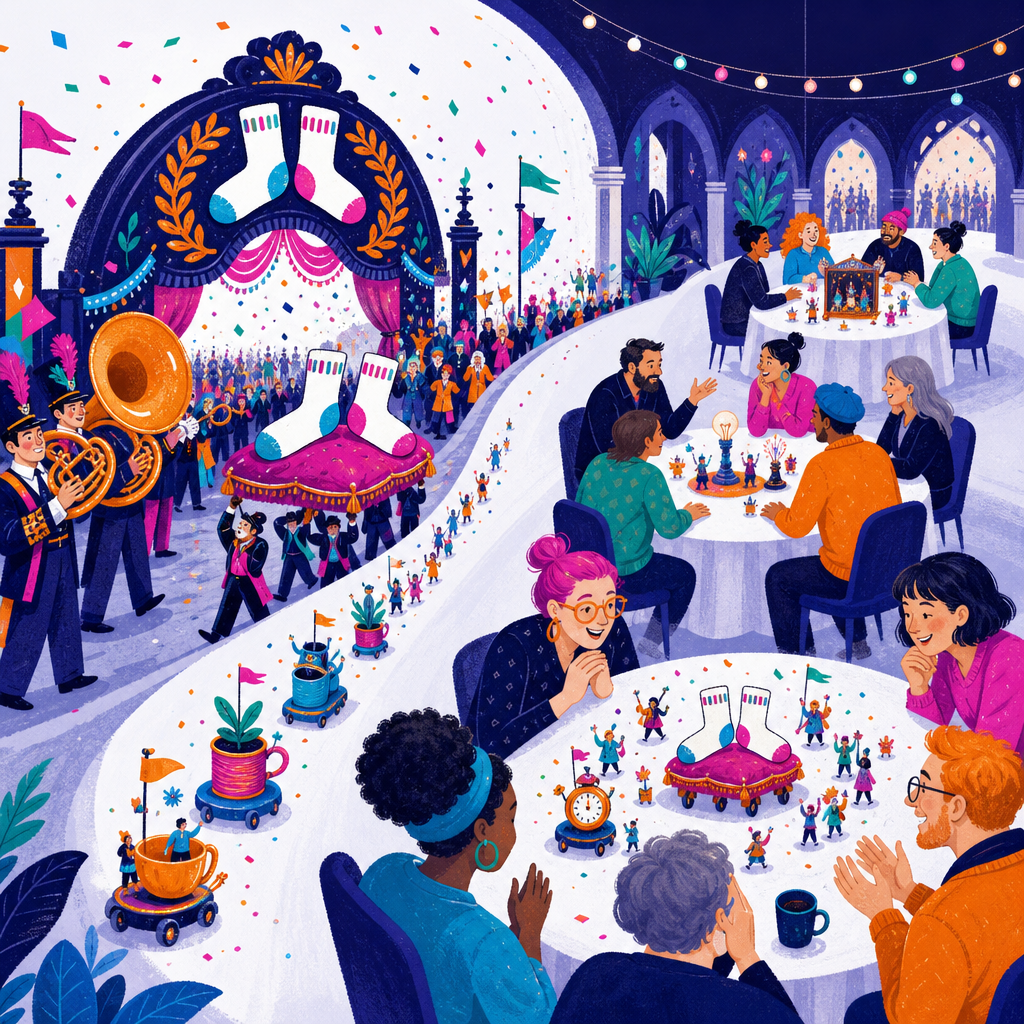
Festival Flip: save the attraction, change the footprint
This exercise suits a meeting-room break or seated offsite session. Participants invent a festival; they do not build attractions, rearrange furniture or perform their plans.
Round one: give tiny triumphs a very grand festival
App prompt
Welcome to the Festival of Tiny Triumphs. Plan a fictional festival for 24 adult visitors in three groups of eight. Each group visits three ten-minute attractions.
You have a courtyard, an adjoining hall and ordinary event equipment. Playful inventions are welcome; nothing will actually be built or booked.
Name your festival and describe three attractions, including what visitors do. Choose your favorite attraction and explain the moment you want visitors to enjoy. Submit one team pitch of about 100 words here. You have seven minutes.
Sample submission
“Festival of Tiny Triumphs celebrates achievements too small for ordinary festivals. At the Grand Victory Parade, eight visitors give an everyday success an absurdly magnificent courtyard procession, complete with marching-band fanfare. At Microscopic Medals, visitors invent grand awards for tiny accomplishments. At Acceptance Speech Studio, they compose a ten-second thank-you for a fictional triumph. Each group rotates through all three. Our favorite is the parade: someone who finally matched their socks gets the welcome normally reserved for an Olympic champion.”
Round two: the courtyard is gone—but the parade stays
The team opens a new app challenge.
App prompt
Venue update: the courtyard is unavailable. Your festival now occupies three large tables in the hall, with eight visitors at each. Attractions must work while visitors are seated, with aisles clear. Visitors may move between tables at scheduled changeovers.
Keep your festival name and your favorite attraction’s central appeal. Adapt all three attractions and describe one specific visitor interaction at your favorite.
Submit a new pitch of about 100 words here. End with “We kept… / We changed…”. You have seven minutes.
Sample revised submission
“Festival of Tiny Triumphs becomes a tabletop celebration. At the Grand Victory Parade, guests appoint ordinary objects as floats. A volunteer announcer gives each fictional achievement an outrageously grand introduction; willing guests hum the sock-matching champion’s fanfare. Microscopic Medals becomes a shared award-design conversation. Acceptance Speech Studio becomes a seated script exchange, with reading aloud optional.
“We kept the delight of treating a tiny success as a huge occasion. We changed the parade’s scale, not its sense of importance.”
The interesting disagreement is what “the parade” actually means. Is it movement? Recognition? Ridiculous ceremony? One colleague can defend the joke, another shrink its footprint, and another ask what each visitor gets to do. The marching band may disappear. The fanfare need not.
Trailer, Take Two: keep the adventure, lose the dialogue
Choose this exercise when colleagues would enjoy shaping a small adventure. Select video or text-storyboard delivery before the event is set up; use that format for both rounds.
For filming, have an empty mug, two teaspoons, two coasters and a strip of blue fabric ready at each team’s table. Safe equivalents are fine. Keep everything dry and tabletop-sized: no water, stunts or shopping expedition required.
Round one: Captain Teaspoon needs a rescue
Video app prompt
Captain Teaspoon is stranded on an island. A river separates her from home, and the Mugboat can rescue her.
Make a trailer lasting about 20 seconds. Establish the stranded explorer, the obstacle and a rescue or cliffhanger. Include a comic or dramatic moment worth keeping. Narration and dialogue are welcome but optional.
Use a simple continuous shot; production polish does not count. Your cast can consist entirely of objects, and nobody must appear on camera. Submit your team’s video here. You have seven minutes.
Sample first video
A teaspoon stands on a coaster island. “Captain Teaspoon is stranded,” the narrator announces. “Only the Mugboat can bring her home.” An empty mug slides across the fabric river. The spoon boards; the mug returns to the opposite coaster, where another spoon waits. Captain Teaspoon rises from the enormous vessel and takes a grand bow. “Some heroes need a bigger cup.”
It is already a complete little adventure. The oversized heroic arrival is worth saving.
Round two: let the action explain it
Video app prompt
Your trailer will now play where nobody can hear it. Keep Captain Teaspoon, the river rescue and your favorite comic or dramatic moment.
Make a new version lasting about 20 seconds. Viewers must understand the problem and rescue from visible action alone. Do not rely on dialogue, narration, explanatory captions or sound effects.
Change the staging or sequence rather than simply repeating the first take silently. Submit the new video to this separate challenge. You have seven minutes.
Sample revised video
The spoon reaches toward the far bank, stops short and retreats to its small island. The mug approaches and pauses beside it. The spoon boards; the mug carries it across the gap. A waiting spoon raises a welcoming salute. Captain Teaspoon returns that absurdly grand bow from inside the mug.
Now the failed reach establishes the obstacle, the crossing supplies the rescue, and the welcome identifies home. The team has not merely removed the narrator. It has given the audience something else to notice.
Prefer not to film? Make the same choices in a text storyboard
A written storyboard is a full storytelling exercise, not a spectator role. Teams still decide what the audience sees, when information becomes clear and how the final joke lands. Submit each version as a free-form text answer to its own app challenge.
Round-one text app prompt
Captain Teaspoon is stranded on an island across a river from home. The Mugboat can rescue her.
Storyboard a trailer lasting about 20 seconds in three numbered frames. For each frame, describe what viewers see and any narration or dialogue they hear. Establish the problem and a rescue or cliffhanger. Include a comic or dramatic moment worth keeping.
Aim for 70–100 words. Submit one team response here; no drawing or filming is required. You have seven minutes.
Sample first storyboard
- A teaspoon stands on a coaster surrounded by blue fabric. Narration: “Captain Teaspoon is stranded, and the river is rising.”
- An empty mug slides toward the island. A hand moves the spoon aboard. Narration: “Only the Mugboat can bring her home.”
- The mug reaches the opposite coaster, where another spoon waits. Captain Teaspoon rises from the enormous cup and takes a grand bow. Narration: “Some heroes need a bigger cup.” Hold the pose so the oversized rescue vessel gets its moment.
Round-two text app prompt
Your trailer will play without sound. Rewrite it as three numbered frames, keeping the explorer, rescue and favorite moment.
Describe only visible action: where objects or characters are, what they do and what changes. No dialogue, narration or explanatory captions. The problem and rescue must be understandable without describing unseen thoughts.
Add one sentence naming the storytelling choice you changed. Submit your new response to this challenge. You have seven minutes.
Sample revised storyboard
- The spoon leans from its tiny coaster toward the distant bank, falls short of reaching it, and retreats. The blue gap fills the frame.
- The mug arrives alongside the island. The spoon steps aboard; the mug carries it across the gap.
- A waiting spoon raises a welcoming salute. Captain Teaspoon stands inside the enormous mug and bows; hold the contrast in scale.
“Changed choice: we replaced the narrator’s explanation with a failed reach, a visible crossing and a welcome home.”
Give the person behind the idea real influence
Before settling on a response, invite each teammate to suggest one thing worth keeping; passing is fine. Make behind-the-scenes participation consequential: someone can question an unclear story beat, choose the visitor interaction, arrange objects or shape the final wording.
The person holding the phone should read back the agreed response rather than silently becoming its author. Invite a different colleague to lead the second discussion without forcing a role swap.
For scoring, request equal completion credit for both rounds in the app. Social Scavenger supports assigned challenge point values. Keep first-round credit intact, with no speed, acting or production-quality bonuses. Celebrate choices through unscored shout-outs such as “favorite idea preserved”—not awards for the employee who supposedly improved most.
Brief a 25-minute pair—or a 50-minute double feature
For one exercise, allow three minutes to brief, seven for round one, one to read the changed brief, seven for round two, five to compare and discuss, and two minutes of buffer. Round times include submitting in the app.
For both exercises, use this 50-minute agenda after access is ready:
| Time | Activity |
|---|---|
| 0–3 minutes | Welcome and participant briefing |
| 3–18 minutes | Festival Flip: seven minutes, one-minute reveal, seven minutes |
| 18–22 minutes | Compare festival choices |
| 22–24 minutes | Reset for the trailer |
| 24–39 minutes | Trailer: seven minutes, one-minute reveal, seven minutes |
| 39–47 minutes | Share selected submissions and debrief |
| 47–50 minutes | Buffer and close |
Extend the session where reading, discussion or submission needs more time rather than squeezing out revision. With many teams, share a selection instead of promising every trailer a screening.
Participant briefing
You will make one version, then receive a new creative brief and make another. Round one is a real attempt, not a trap. Keep something you like. Submit each version to its own app challenge. Nobody has to appear on camera, and every teammate can influence the idea. We will compare the choices in the two versions—not rank the people who made them.
Arrange seated workspaces, readable prompts and a suitable discussion pace. Read prompts aloud when useful while keeping challenges and submissions in the app. Ask about individual participation needs; a silent film is not automatically accessible to everyone. Agree who can see submissions, any later sharing and retention arrangements, and keep confidential information out of shot.
Copyable organizer inquiry
We would like a custom app-based session using [Festival Flip / Trailer, Take Two / both]. Our group size is [number], venue is [place], date is [date] and activity window is [duration]. Our trailer format is [video / text storyboard].
Please prepare separate first- and second-round challenges, with a planned changed-brief reveal and equal completion credit. We want seated participation and no requirement to appear on camera.
Please scope game preparation, facilitation and support responsibilities, device and access arrangements, recording length if filming, submission sharing and relevant costs.
Debrief the choices, not the people
Pick two questions, not a full postmortem.
After Festival Flip:
- What was our favorite attraction’s real appeal?
- Which part could change without losing it?
- What did the tabletop version make possible that the courtyard version did not?
After Trailer, Take Two:
- Which fact depended on narration in our first version?
- What visible action replaced that explanation?
- Which moment did we preserve because we liked it, rather than because it was easiest to keep?
A clearer trailer or a more workable festival pitch is a result inside this game—not a measure of employee ability or proof of workplace learning. The satisfying finish is simpler: the team can point to something it chose, changed and still likes. The courtyard is gone. The sock champion still gets a parade.