


 Amazing Race
 Choose Wisely
 Unlock the Box
 Mall Hunters
 Mission Impossible
 The Great Charity Race
 Clues to a Mystery



 Random Acts of Kindness


 Scavenger Hunt From Home
 Where in the World is the Crystal Snow Globe?
 The Big Escape
 Team Trivia
 The Feud
 Summer Olympics
 Winter Olympics
 Who Kidnapped Santa?





“The street festival. Our visitor would talk to every stallholder.”
“Same choice. Mine wants a crowd big enough to disappear into.”
In this sample app-based welcome, two colleagues have picked the same fictional outing for completely opposite reasons. A teammate captures both in their joint response. Nobody has introduced their entire life. They already have something to discuss.
For icebreaker games for big groups with staggered arrivals, use independent dilemmas at prepared team tables. Human greeters bring newcomers into the discussion; each person can influence an answer without catching up on earlier rounds.
Same Choice, Different Reasons explores contrasting motives. One Condition Changes Everything tests whether a small detail changes a decision. Below are six app prompts and a completed plan for 120 colleagues arriving from 8:40 to 9:00, with the main event starting at 9:05.
This welcome suits an in-person conference, onboarding gathering or offsite where attendees can remain at their tables for the opening session.

Same Choice, Different Reasons
Each team opens a dilemma in the Social Scavenger app, takes a quiet moment to choose, then compares reasons. The task is to keep one option and find two contrasting reasons someone might choose it.
Allow three to four minutes per prompt: roughly thirty seconds to think, two minutes to compare, then time to agree and submit. Social Scavenger’s free-form text challenges let teams submit the option and both reasons together. After submitting, move to another independent prompt—or pause for introductions.
The afternoon outing
Your fictional visitor has one free afternoon: a lively street festival or a quiet observatory. Choose one. Find two contrasting reasons for choosing that same option. Submit the option and both reasons.
A joint response: “Festival: one visitor wants a conversation at every stall; the other wants to enjoy a crowd without being expected to speak.”
The destination matches. The desired afternoon does not. That is the discovery worth discussing—not which colleague supposedly belongs to which personality type.
The mystery ticket
For a fictional mystery evening, choose knowing the ending before the story starts or keeping it secret until the end. Submit one choice and two contrasting reasons guests might prefer it.
A joint response: “Know the ending: one guest wants to relax without suspense; another wants to scrutinize every clue and decide whether the ending holds up.”
The imaginary museum
Choose a visit to Almost-Working Inventions or Perfect Replicas. Submit your chosen museum and two contrasting reasons fictional visitors would go there.
A joint response: “Almost-Working Inventions: one visitor wants to work out how to repair everything; another wants to enjoy the gloriously broken machines exactly as they are.”
One visitor sees a repair project. The other sees an exhibit that must not be touched.
What if the first choices differ?
Nobody needs to surrender a genuine preference. Pick either option as a fictional assignment and invent two visitors who would choose it for different reasons. If the reasons sound alike, ask: “Who would choose this while wanting the opposite experience?”
People may answer for themselves, but personal disclosure is never required. The joint submission records a contrast, not unanimous personal agreement.
One Condition Changes Everything
Here, the app prompt contains a choice followed by one changed condition. Discuss an initial choice, consider the condition, then submit first choice, final choice and why. Both parts sit in one self-contained challenge—not separate rounds that a newcomer could miss.
Again, allow three to four minutes. Staying put is just as valid as switching.
The unreliable travel upgrade
Your fictional traveler can take a pocket-sized dragon that gives excellent directions or a suitcase that packs itself. Choose one. Now consider this: the dragon refuses to take the shortest route. Keep or switch? Submit your first choice, final choice and reason.
Switch: “Dragon → suitcase. Our traveler has a train to catch. A scenic detour is not helpful today.”
Stay: “Dragon → dragon. The detour is the point of this trip.”
A newcomer can change the discussion with one question: “Does this traveler actually need to get anywhere on time?”
The shared explorer gift
Choose a gift for a fictional explorer: a compass pointing toward the best story or a notebook that draws whatever its owner imagines. Now the gift must be shared with another explorer. Keep or switch? Submit your first choice, final choice and reason.
Switch: “Notebook → compass. Two people imagining different things could produce a very confusing map.”
Stay: “Notebook → notebook. One imagines the expedition; the other adds the creature they hope not to meet.”
The souvenir department
Your imaginary museum can hire a robot to name its souvenirs or a robot to wrap them beautifully. Choose one. New condition: the naming robot can only make puns. Keep or switch? Submit your first choice, final choice and reason.
Stay: “Naming robot → naming robot. ‘Mug-nificent’ belongs in this museum.”
Switch: “Naming robot → wrapping robot. Our visitors deserve one purchase without a joke attached.”
Save this short dilemma for the final arrivals. Inventing a pun is optional; deciding whether the museum should employ a pun-making robot is plenty.
120 colleagues, twenty minutes of arrivals
Prepare twenty table teams of six, using the same seats for the main event. Assign teams beforehand and keep those identities stable as people arrive.
- Twenty participant connectors: one per table, included within the 120 attendees. Brief them beforehand and ask them to be ready at 8:40. They welcome colleagues, open prompts, invite contributions and handle submissions.
- Seven non-playing personnel: one welcome lead, four greeters and two joining/access helpers. These are separate from the 120 players.
Before doors open, agree team access, test venue connectivity and position help beside—not across—the entrance. Tell connectors to reserve the souvenir dilemma for 9:00. The six prompts are a menu, not a checklist everyone must finish.
| Time | Attendees present | What happens |
|---|---|---|
| 8:40–8:45 | 40, including the 20 connectors | Greeters introduce arrivals to their table connector. Begin when a connector and another colleague are ready; do not wait for six people. |
| 8:45–8:55 | 90 after 50 more arrive | Show newcomers the complete current prompt and invite a contribution before submitting. If the answer was just sent, open another unused dilemma. |
| 8:55–9:00 | 120 after the final 30 arrive | Continue introductions. Finish current responses without launching a lengthy new discussion. Keep the souvenir prompt available. |
| 9:00–9:04 | 120 | Use the protected final conversation for the souvenir dilemma, including thinking time and a joint submission. |
| 9:04–9:05 | 120 | Close the welcome and turn attention to the main event, in the same seats. |
| 9:05 | 120 | Begin the main event. No table reports or winner reveal. |
The greeter’s handoff matters more than pointing toward an empty chair:
“Welcome—no catching up needed. This is your table, and this is Jo. Jo will show you the whole question. You can answer for an imaginary person, suggest a reason or listen first.”
Three arrivals, three ways into the conversation
8:42: Alex arrives early. Alex joins the festival discussion and suggests that someone might love a crowd precisely because they can remain anonymous. The connector includes that reason in the app response. Alex continues with other prompts as colleagues join—not with instructions to collect the most completions.
8:51: Sam arrives midway. The table is discussing the dragon. The connector shows the full prompt and asks whether a detour would help their fictional traveler. Sam asks about the traveler’s deadline. That question changes the joint answer; earlier submissions are irrelevant.
9:00: Ren arrives last. A greeter brings Ren into the reserved souvenir conversation. After reading and thinking, Ren suggests keeping the naming robot because the museum itself is deliberately ridiculous. The team includes that reason and submits before 9:04. Ren has influenced something, rather than watched everyone else finish.
Bring the welcome to the seated participant
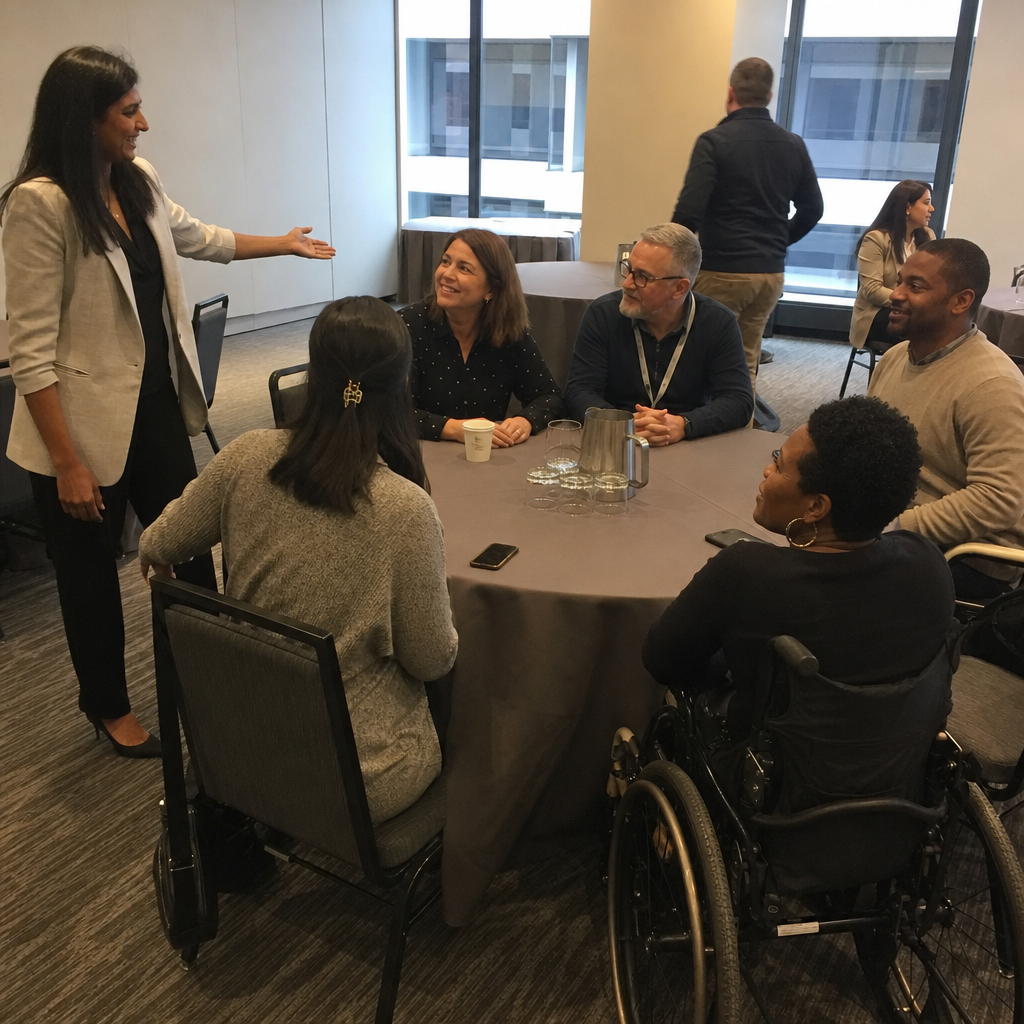
Bring arriving colleagues to their table, rather than requiring anyone to circulate. Make the complete digital prompt readable and within reach, with read-aloud support when useful. Someone can point to an option, contribute wording on the team device or indicate agreement without making a speech.
Ask privately about access and communication requirements before fixing the agenda. Government of Canada inclusive-meeting guidance recommends early accommodation planning and assessing the actual venue. Keep agreed support available during arrival, not just during the main session.
Social Scavenger’s planning FAQ describes a team captain operating the app. Confirm that shared-device arrangement for this custom welcome so each newcomer need not complete an individual sign-in before contributing.
A joining problem should not become someone’s entire welcome. Let them contribute through the team’s working device while a helper assists. If that device has trouble, bring help to the table instead of sending everyone back to the entrance. These six challenges require text responses, not photographs; include camera-free joining in the booking request too.
Do not turn arrival time into a score
Request equal in-app completion credit per prompt, without speed bonuses, arrival-time rankings or rewards for completing the most. Equal prompt values alone do not make totals fair: early arrivals still have more playing time. Welcome totals should give no advantage in the main event.
Social Scavenger supports challenge values and human judging. Agree review responsibilities and the noncompetitive presentation with the producer. The submission preserves a shared answer; it is not a measure of punctuality or persuasive talent.
9:04: close the game, not the welcome
The welcome lead gives one clear instruction:
“Finish and send your joint response. Thank someone whose reason surprised you. We’re starting here in one minute.”
At 9:05, begin. Do not add twenty table reports. Anyone arriving after the welcome closes is greeted and seated directly, without a compulsory catch-up game.
Request this opening through Social Scavenger’s custom-game services. Send this brief with your venue and date:
We are planning a welcome for 120 colleagues arriving from 8:40 to 9:00, with a final conversation until 9:04 and the main event at 9:05. Please scope Same Choice, Different Reasons and One Condition Changes Everything as custom app-delivered text challenges for twenty prepared table teams. We will provide participant connectors, greeters and joining helpers. We want shared team submissions, fictional choices, seated participation and completion credit without competitive rankings. Please confirm custom-content scope, team access, camera-free joining, accessible prompt delivery, response visibility, scoring review, support responsibilities and fees.
The last arrival should leave the welcome with a reason in the team’s answer—not a catch-up assignment.