


 Amazing Race
 Choose Wisely
 Unlock the Box
 Mall Hunters
 Mission Impossible
 The Great Charity Race
 Clues to a Mystery


 Random Acts of Kindness

 Where in the World is the Crystal Snow Globe?
 The Big Escape
 Team Trivia
 The Feud
 Summer Olympics
 Winter Olympics
 Who Kidnapped Santa?





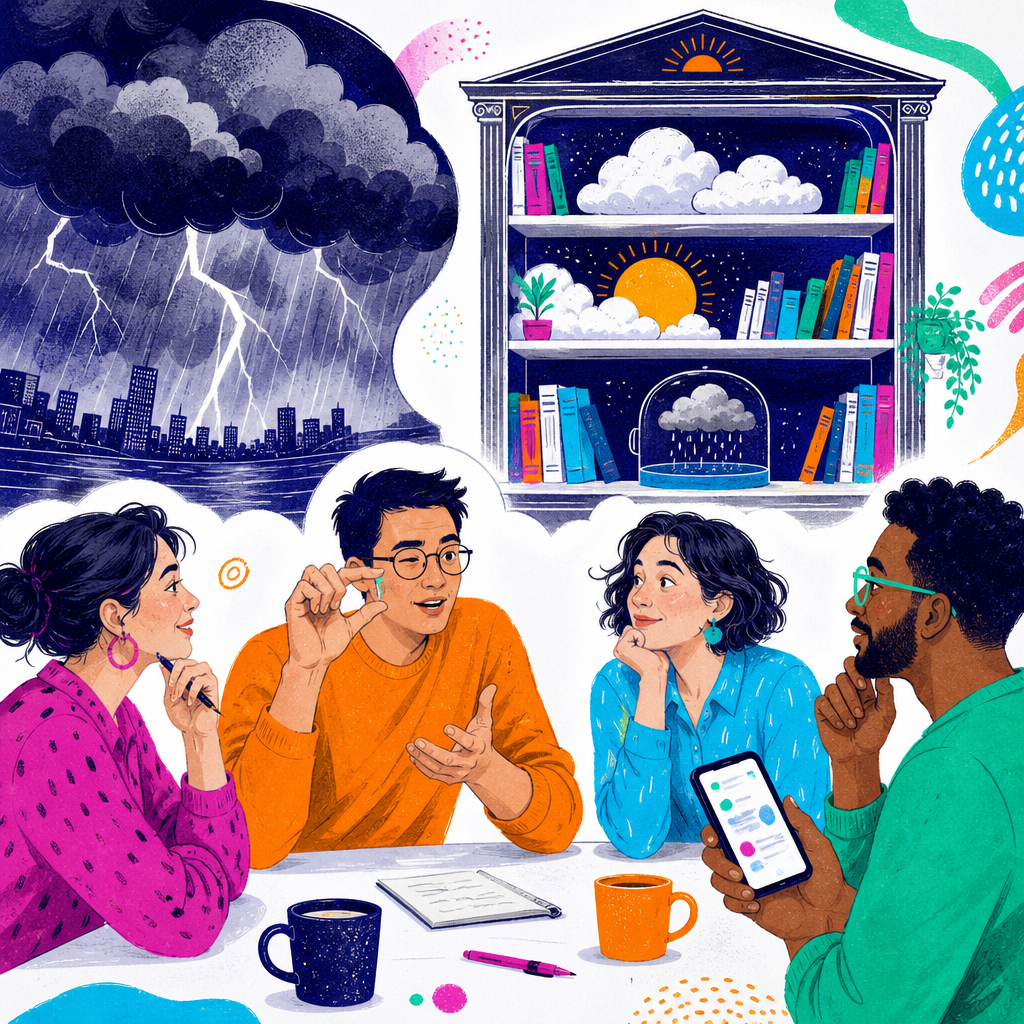
A library that lends weather has a customer-service problem. In this sample app-based icebreaker, Maya wants to try a thunderstorm before borrowing it.
“Two minutes of drizzle,” someone across the table counters. “No indoor hurricanes.”
The group likes Maya’s sampler idea. The negotiation is about how much weather constitutes a reasonable free trial.
When choosing icebreaker games for corporate events, consider what people will say the next time they meet. Borrow a Better Idea gives unfamiliar colleagues a shared reference: invent an unlikely visitor attraction, exchange improvements with another group, then reconnect to reveal what changed.
It suits an in-person conference, onboarding gathering or offsite with room for two encounters. The plan below covers 60 attendees, a 25-minute opening and an eight-minute return later in the agenda. The goal isn’t collecting the most names. It’s having a specific next sentence: “We used your drizzle sampler.”
The first encounter: borrow something worth keeping
Invent an attraction with room for improvement
Each group opens this challenge in the Social Scavenger app:
Invent an unlikely visitor attraction. It could be a library that lends weather, a museum of future mistakes or a hotel for unfinished dreams. Agree on its name and a one-sentence promise to visitors. Submit both as one team response.
Group A submits: “Weather Library — Borrow the weather your weekend needs.”
Five minutes is enough for this first round. Nobody needs a business plan or an explanation of cloud storage. They need a promise another group can improve.
Social Scavenger’s free-form text challenges collect teams’ written ideas. All three prompts and responses stay in the app; a human host handles the pairings.
Be each other’s visitors
After introductions, the paired groups take turns pitching. Group B brings the Museum of Future Mistakes: “See tomorrow’s blunders today.”
Maya, from B, proposes sample-size weather for A’s library. Jonah, from A, suggests a do-over door for B’s museum: visitors can choose a different ending. Someone objects that erasing every mistake would leave the museum empty. The compromise? Keep the original disaster on display, but let visitors try another outcome.
Both groups have given something and received something. Neither has to accept a suggestion unchanged.
The exchange challenge in the app reads:
Meet your host-assigned partner group. Take three minutes for each attraction: share its promise, ask a visitor question and offer improvements. Then return to your original group and choose one suggestion to adopt or adapt. Submit your attraction, the improvement, the contributor’s first name as they want it credited, their group and your conversation zone. Explain what changes for visitors.
Group A’s response:
Weather Library — Add a two-minute drizzle sampler before visitors borrow a storm. Suggested by Maya, Group B, Zone 1. Visitors can try a little weather before committing.
Read the response back to the contributor before sending it. “We kept your trial-size idea but reduced the thunder” is a real design decision—and something to revisit later.
Seat 60 people for six simultaneous exchanges
Create 12 groups of five, A through L, in six conversation zones. Each zone seats ten people in two distinct five-person groups within easy speaking distance. Mix departments where useful while respecting access needs.
Host-assigned pairings: Zone 1: A–B; Zone 2: C–D; Zone 3: E–F; Zone 4: G–H; Zone 5: I–J; Zone 6: K–L.
Everyone has a partner group; nobody waits for a station. Keep the exchanges seated rather than asking half the room to rotate. For this plan, assign a non-playing host and a roaming helper, separate from the 60 players.
Complete app joining and device checks during arrival, before 9:00. Each group designates an app submitter; agree the team-access and device arrangements when booking.
| Time | What happens |
|---|---|
| 9:00–9:03 | Host welcomes everyone. Within each group of five, share first names and brief work context. |
| 9:03–9:08 | Open the invention challenge, discuss and submit the attraction’s original promise. |
| 9:08–9:10 | Host confirms pairings. Introduce names and work areas across the two groups. |
| 9:10–9:16 | Exchange pitches, visitor questions and improvements: three minutes per attraction. |
| 9:16–9:21 | Each original group chooses an improvement, checks the credit and submits its borrowing record. |
| 9:21–9:25 | Thank the partner group. Host explains the return visit and allows transition time. |
At the pairing moment, the host can say:
“A and B, you’re each other’s visitors in Zone 1. Everyone’s partner is the other five-person group in their zone. Introduce yourself with your name and where you work in the organization. Each side gets three minutes to pitch and hear visitor ideas. Say your name when you offer a suggestion. Stay seated—there’s no whole-room presentation. At 10:40, you’ll meet here again to show what you borrowed.”
10:40: show them what made it in
Protect the second encounter instead of hoping it happens beside the coffee urn. In this agenda, a plenary runs from 9:25–10:25, followed by a break until 10:40. The return visit comes before the next session.
- 10:40–10:42: Regather in the same zones and briefly reintroduce names. This isn’t a memory test.
- 10:42–10:46: Give each group two minutes to reveal its revised promise, credit the contributor and hear a reaction or follow-up question.
- 10:46–10:48: Each group submits its callback response in the app.
The third app challenge reads:
Tell your partner group what you adopted and how you changed it. Then submit your revised visitor promise, the contributor’s credit and one reaction or new question from this return conversation.
Group A submits:
Weather Library — Borrow the weather your weekend needs; try a drizzle before committing to a storm. We adopted Maya’s sampler idea from Group B, Zone 1. Her next question: can visitors renew sunshine if their picnic runs late?
Group B has an update for Jonah too: “Your do-over door made it in. Our promise is now ‘See tomorrow’s blunders—and choose a different ending.’”
Keep these reveals at the tables. Twelve presentations would turn a conversation into an audience exercise.
If the intended partner is unavailable
If Maya has stepped out, another member of Group B hears the update; Maya still receives the credit. If all of B is unavailable, the host assigns an available listener, such as the roaming helper. Group A explains the idea’s origin and records the replacement listener’s reaction.
Nobody searches the venue or loses completion credit because another attendee is absent.
Make the return possible for everyone
Keep the same seated meeting points available for both encounters. If someone needs to remain at their place during the break, bring their partner group back there rather than requiring them to find it.
Suggesting an idea, asking a visitor question, choosing wording and entering the response are all useful contributions—not exclusive job assignments. Allow quiet thinking time and invite another perspective before settling on an answer. Someone can pass on pitching and still shape what the group submits. No photographs, acting or personal stories are required.
Read app prompts aloud when helpful and avoid competing background music. Following Government of Canada inclusive-event guidance, ask privately about accommodation needs, budget for support and assess the actual venue. Check digital access and communication needs individually; a seated layout alone does not resolve them.
Agree who will see submissions, and keep confidential work information out of the fictional attractions.
Keep scoring light: request three equal-value completion challenges in the app, with no speed bonuses or rewards for collecting names. Social Scavenger’s scoring tools support challenge values and human judging; agree who reviews responses and clarifies attribution. Ties are fine. The interesting result is what changed, not which table typed fastest.
When five minutes is enough
A familiar team that only needs to start talking may not need two encounters. Neither does an agenda without a protected return slot.
Within an app-based event, use a short Room Upgrade challenge instead:
Give this meeting room one impossible helpful feature and one small drawback. Agree and submit both.
Allow one minute for introductions, two for discussion, one to submit and one to share at the table. A response might be: “A door that takes you straight to your next meeting—but announces every arrival with a trumpet fanfare.” The enjoyable disagreement is convenience versus a discreet entrance. No later reunion is necessary.
A brief that protects the second encounter
Social Scavenger’s custom-game services include adapting existing games and building new ones. Scheduled challenge availability can support the later callback; the host still pairs and regathers attendees. Scope this as custom work rather than assuming it is included in a standard package.
Send this brief with your venue and date:
We’re planning an in-person event for 60 colleagues at [venue] on [date]. We want 12 groups of five to invent unlikely visitor attractions, exchange improvements in six host-assigned pairs, then reconnect to show what they adopted and credit its contributor. Please scope a 25-minute opening at 9:00 and an eight-minute callback at 10:40, using three app-delivered text challenges and equal completion scoring. Participation should work seated without required photos or performance. We will provide an internal host and roaming helper. Please confirm team access, accommodation arrangements, submission visibility, setup responsibilities, scoring review, game-day support and the custom-work fee.
The useful finish is modest: someone has a reason to approach a colleague again, with something new to say. “We used your drizzle sampler” gets the second conversation started. Sunshine renewals can take it from there.