
 Amazing Race
 Choose Wisely
 Unlock the Box
 Mall Hunters
 Mission Impossible
 The Great Charity Race
 Clues to a Mystery


 Random Acts of Kindness

 Where in the World is the Crystal Snow Globe?
 The Big Escape
 Team Trivia
 The Feud
 Summer Olympics
 Winter Olympics
 Who Kidnapped Santa?





Finding five objects gives coworkers a checklist. Recovering the missing chapter of a company story gives them a mystery. The difference matters: a workplace treasure hunt game becomes a collaborative mission when progress depends on comparing observations, explaining decisions and using someone else’s contribution—not simply moving fastest.
Social Scavenger offers city games, venue-based poster games and live-hosted virtual experiences when an established format is a better fit than building everything yourself. DIY can work when someone has time to write, test and facilitate the hunt. An organized experience is worth exploring when you want to hand over specific production responsibilities. Either way, start with the mission—and decide how you will know it worked.

From hidden treasure to a shared workplace mission
A treasure hunt traditionally uses clues to guide participants toward a concealed prize. A scavenger hunt traditionally asks people to find or collect specified items, often within a time limit. That distinction is useful, but modern team games can mix discovery, puzzles and creative challenges.
For work, the treasure does not have to be a physical object. It could be a recovered message, the answer to a mystery or a final reveal that connects everyone’s discoveries. Nor does every Social Scavenger format follow a sequential clue-to-clue structure.
The enduring appeal is easy to understand: an unanswered question invites curiosity, clues create moments of discovery, and a reveal gives the experience a destination. Two famous hunts show both the possibilities and the pitfalls.
The 1979 golden-hare hunt: make the story matter
A celebrated illustrated-book hunt launched in 1979 embedded riddles and visual clues in a story that pointed readers toward a hidden jeweled hare. The narrative and the search belonged together.
The workplace lesson: each clue should advance the mission. Adding a company logo to unrelated trivia is decoration; asking colleagues to reconstruct a pivotal company decision gives the history a role in the game.
The French owl hunt: borrow the intrigue, not the difficulty
A French owl-themed hunt began in 1993. The token’s discovery was announced on October 3, 2024, and solutions were publicly presented in May 2025.
A decades-long mystery is memorable, but it is not a model for an employee event. Borrow the compelling central question, then provide understandable clues, useful hints and a satisfying finish within the event.
What two documented workplace hunts actually did
Two employer-published recaps—not Social Scavenger customer stories—illustrate how a hunt can serve a workplace purpose.
A values launch that moved beyond slogans
At a US personalized-products company’s 2019 values-launch event, teams followed clues to tokens representing core values. Employees then presented what those values meant and recognized colleagues who demonstrated them.
The useful design choice was what happened after discovery. Finding a token opened a conversation about behavior, rather than ending with a correct answer. The recap documents the activity, not measured business improvement.
A city hunt within a broader retreat
A US agricultural cooperative’s June 2025 employee retreats brought together colleagues from different business units. One retreat included an interactive city scavenger hunt alongside company updates and purpose-focused programming.
This shows another role for a hunt: a shared experience within a larger employee gathering. It does not establish that the hunt’s clues incorporated company values or that the game alone caused the retreat’s reported benefits.
Design backward from the final reveal
Before writing a clue, choose one behavior you want employees to practice. Perhaps it is asking another department for context, explaining a decision or making room for an observation the group nearly missed. Then make that behavior necessary to progress.
Consider the following fictional mission, “Recover Our Next Chapter.” It is a planning example, not a customer case or an advertised Social Scavenger package.
Act one: discover what brought the company here
An imaginary company archive has lost its final entry. Teams begin with approved digital excerpts about a real milestone: a difficult launch, an early customer problem or a change in how the business worked.
Instead of asking employees to recall a date, ask them to reconstruct what happened and identify the decision that made the difference. Supply every fact needed inside the challenge so a new hire can contribute as meaningfully as a longtime employee.
Act two: decide what the company stands for
The next discovery introduces a fictional dilemma connected to a stated value. If that value is accountability, for example, a team might decide what to communicate when a deadline is at risk and who needs that information.
Ask for a reason, not just the value’s name. The approved story supplies context; the discussion reveals how colleagues interpret the value. Keep the scenario fictional rather than turning a real employee dispute into entertainment.
Act three: recover the next chapter together
Different teams receive complementary information and must combine their findings to complete the missing entry. The reveal connects the historical lesson to a current objective, such as clearer cross-department handoffs. Each team identifies one behavior to carry into the following week.
A physical prize is optional. Friendly competition can remain, but the ending should celebrate what people discovered together—not only which team finished first.
Build in varied contributions: noticing details, interpreting evidence, checking reasoning and explaining an answer. Let people choose or rotate roles. Ask about mobility, sensory, language and technology needs, and provide meaningful alternatives to appearing on camera. Quiet participation should not mean being assigned a peripheral job.
Take a company-story brief to Social Scavenger
Customization should influence what colleagues do, not only what they see. Bring Social Scavenger your group size, location and goals, plus a concise brief describing the experience you want:
- Brand: approved visual assets and language you would like reflected.
- Culture: recognizable, approved stories about how people work together.
- History: the milestone that establishes the opening mystery.
- Values: the decisions you want employees to discuss.
- Objective: the collaborative behavior the finale should connect to everyday work.
Ask what can be tailored in your chosen format. Bespoke story writing, branded interfaces and company-history integration should be confirmed rather than assumed. The three-act mission above is a brief to discuss, not a description of standard product features.
City discovery: make priorities part of the conversation
Social Scavenger’s city scavenger hunts include Ultimate City Scavenger Hunt, which offers 45+ challenges in a walkable area without enough time to complete everything.
That constraint gives your debrief a useful question: how did the team agree on what mattered most? You can observe how colleagues propose priorities, respond to new information and decide when to change direction. Discuss whether your company-story theme can fit the selected game; do not assume it includes a collective narrative finale.
At your venue: put discovery into the space
For interactive poster games, Social Scavenger prints and ships posters to your venue. Teams uncover hidden clues, solve puzzles and complete creative photo, video and AI challenges before a leaderboard and slideshow reveal.
This is a concrete clue-and-discovery option for an office or event venue, with poster production handled by Social Scavenger. Ask what company content can be incorporated and how your intended closing message might fit alongside the reveal. Custom-branded posters are not something to assume is included.
For distributed colleagues: explore a hosted mystery
Social Scavenger’s virtual team-building games include live-hosted mysteries, game shows and creative challenges. Hosting is a meaningful difference from DIY: the organizer can participate rather than also serving as the game host.
If shared deduction is central to your mission, start the conversation with the mystery options. Ask whether the desired treasure-hunt storyline can be accommodated, and explain participants’ language, sensory and technology requirements before selecting an experience.
Assign production ownership before commissioning the hunt
The practical DIY-versus-Social Scavenger comparison is about who owns the work—not which option promises better teamwork.
DIY: your team owns the entire story
A DIY treasure hunt gives you responsibility for the narrative, clues, permissions, testing and final reveal. Someone must also prepare participation alternatives, help teams that get stuck and run the debrief. Test with a person who does not already know the answers; the writer is rarely a reliable judge of clue clarity.
Organized: identify the work you are handing over
With Social Scavenger, the confirmed responsibilities depend on the format. Poster games include printing and shipping. Virtual games include live hosting. For city games, discuss event support alongside the specific game you are considering.
Agree explicitly on who will write and test any tailored content, approve company references, support participants and facilitate the closing discussion. Ask what reporting, if any, is included. A leaderboard or slideshow does not establish that learning analytics or downloadable evaluation reports are available.
Bring these questions to a consultation with Social Scavenger. A clear division of responsibilities helps you judge the preparation you will actually save.
Measure what the winning score cannot tell you
Reasonable objectives include more cross-team conversations, opportunities to practice information sharing and clearer discussion of company values. Treat these as outcomes to evaluate, not guaranteed changes.
A 2017 meta-analysis of teamwork interventions supports the value of structured teamwork interventions across varied settings. It is not evidence that a single corporate treasure hunt improves retention, productivity or revenue.
You can run a small evaluation independently of any game reporting. Keep the data minimal and aggregated, explain photo and video participation choices, and never use game scores to rank employees for workplace performance decisions.
Establish a baseline for one or two objectives
- For connection, ask before and after the event: “I know whom to approach outside my department when I need help.” Use the same response scale both times.
- For values learning, use a short workplace scenario and ask participants to explain a decision. Repeat a comparable scenario afterward rather than testing slogan recall.
- Report response counts and response rates alongside the results. A change in who answers can affect the apparent change in scores.
Observe the route to the answer
A facilitator can manually record team-level challenge attempts, completions, recurring hint requests and participation barriers. Notice whether teams ask for another perspective before settling on an answer.
Keep attempts and completions separate. An optional challenge that nobody chose is different from one that every team attempted but could not understand. In Ultimate City Scavenger Hunt, leaving some challenges unfinished is expected because there is not enough time to complete everything.
Separate enjoyment, learning and later behavior
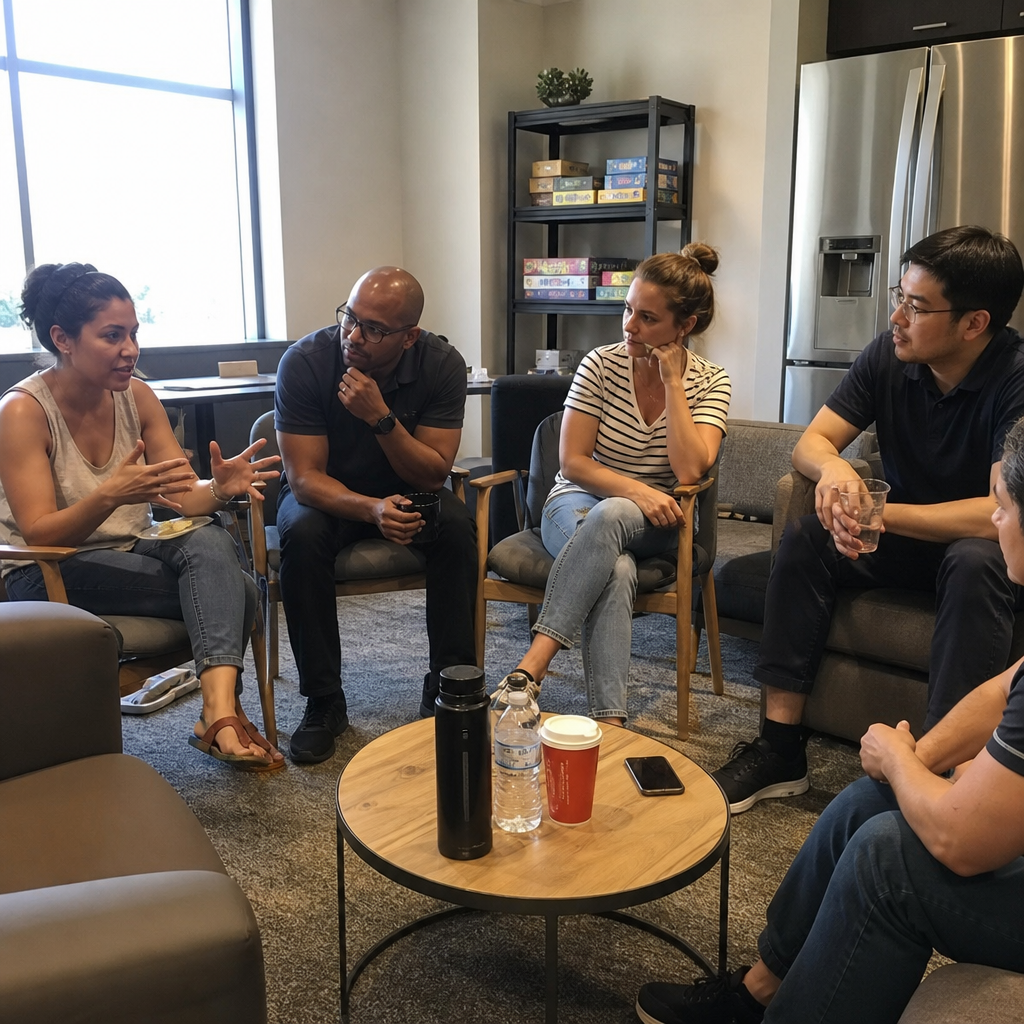
Ask whether people enjoyed the event, but do not stop there. A short debrief can connect the experience to work:
- When did another person’s information change your answer?
- Whose contribution did we nearly miss?
- What will we do differently next week?
After one or two weeks, ask whether participants contacted a colleague they met or used a behavior discussed in the debrief. Keep immediate enjoyment, demonstrated learning and later behavior separate in your recap. A before-and-after pulse can guide improvement; it does not prove that the event caused a business outcome.
Let the findings rewrite the next hunt
The most useful event data points toward a design change:
- Repeated requests for the same hint suggest reviewing clue wording and testing it with fresh readers.
- Uneven contribution suggests reconsidering roles, information distribution or the ways people can respond.
- Weak values reasoning suggests replacing slogan trivia with a more meaningful decision.
- Limited cross-department conversation suggests revisiting team composition and whether the task genuinely requires different perspectives.
Use the same core evaluation questions next time and record what you changed. Look for patterns rather than declaring success from a single enthusiastic comment or a high game score.
A worthwhile treasure hunt game gives employees something to solve together—and something useful to discuss afterward. Bring Social Scavenger your company story, desired behavior and evaluation goals, then explore which format and confirmed tailoring options can support that mission.