

 Amazing Race
 Choose Wisely
 Unlock the Box
 Mall Hunters
 Mission Impossible
 The Great Charity Race
 Clues to a Mystery


 Random Acts of Kindness

 Where in the World is the Crystal Snow Globe?
 The Big Escape
 Team Trivia
 The Feud
 Summer Olympics
 Winter Olympics
 Who Kidnapped Santa?




Start with an existing experience. Buy customization only when it improves what colleagues get to investigate, decide or create together. A ready-made game can be the right purchase—not a compromise on the way to something bespoke.
For corporate event experiences, the useful distinction is simple: keep the original when the shared adventure already fits; personalize when a company detail improves a particular moment; build from scratch when your context needs to shape the whole game.
Here is a sample event plan with three participant moments, a completed comparison and an annotated brief. The question throughout: what does the extra creative work actually give the people playing?
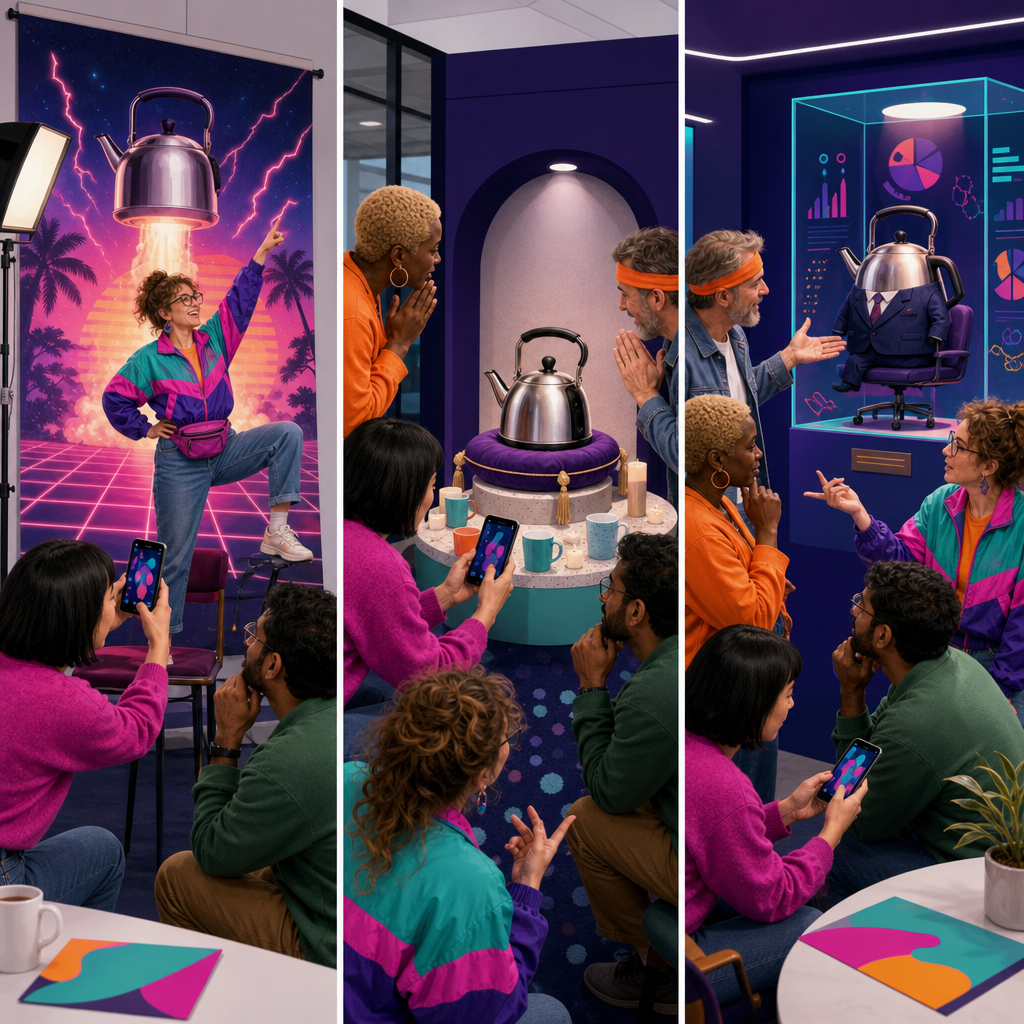
The same event, three creative scopes
Hold the essentials steady: 60 colleagues, one hotel meeting suite and a desired 90-minute total event block. The group includes different departments and lengths of service. Our working arrangement is 12 teams of five, with 10 minutes to join and brief, 65 minutes to play and 15 minutes to finish together. Setup happens separately.
The established starting point is Great Scott!, which combines decade-themed puzzles with creative photo and video challenges. Its interactive poster format brings the game into a venue: teams investigate displays, scan QR codes and respond through the app. Assume this group has not played it before.
Social Scavenger offers both customization of existing games and ground-up game creation. Here is how those creative scopes compare for this event.
| Consideration | Established Great Scott! | Great Scott! with selected company content | Ground-up concept |
|---|---|---|---|
| Relevance | A shared adventure suited to the group’s interests. | A recognizable company story becomes something everyone can play with. | Company context shapes the story and decisions throughout. |
| Novelty | New to these participants, even though the format already exists. | A company-specific surprise within the established adventure. | A new premise and sequence—not necessarily more technology. |
| Content approvals | Theme suitability and media arrangements; no company stories to author. | Selected facts, images, names and tone. | Premise, source material, challenges, visuals and ending. |
| Preparation demands | Teams, venue and access planning; no company-content collection. | The same logistics, plus a bounded asset request and review of changed moments. | The same logistics, plus context gathering and decisions about the whole experience. |
| Messaging overload | Easiest to avoid if the game remains a break from presentations. | Risk grows with every extra departmental mention or insider question. | Easy to overfill if every stakeholder expects a compulsory lesson. |
| Choose it when | The existing premise already gives colleagues something appealing to do. | A milestone or shared story deserves a moment, not an entire new game. | The desired participant experience cannot be achieved through a few changes. |
What changes when a team opens a challenge?
Ready-made: the adventure supplies the shared reference
A team scans a decade poster and opens a photo-recreation challenge in the app. The task: capture the exaggerated drama of a movie-poster pose.
One colleague notices that the silhouette matters more than the costume. Another directs a willing teammate to look slightly more alarmed. Someone suggests using a jacket to create the impression of a heroic wind. The photographer points out that the result currently looks like a difficult commute.
They adjust, submit their photograph through the app and move to a puzzle. In a few minutes, they have made several decisions together without needing to know anything about the employer.
What you are buying: an existing premise and a varied challenge mix. The relevance comes from what this group does together—not from how often the company’s name appears.
Personalized: one familiar detail changes the moment
Keep the same Great Scott! adventure, but replace a suitable creative challenge with a company time capsule. The app supplies the context: the first office had three desks and one shared kettle. Teams must turn those modest beginnings into an absurdly grand commemorative photograph.
A new hire proposes giving the kettle the seat of honor. Another teammate arranges a solemn delegation of mugs. A longer-serving colleague suggests a low camera angle: the kettle should look important enough to approve expenses.
The team submits its photograph in the app, then returns to the decade-themed adventure. The joke works because everyone received the story—not because someone remembered an obscure founding date.
What changed: the subject of their shared invention. The main story, pacing and mix of challenges remain intact. That can be enough for an anniversary celebration without turning the afternoon into a company-history examination.
Built from scratch: company context becomes the adventure
Now commission a new venue-based concept: The Museum of Almost-True History. A future curator has assembled an exhibition about the company and confidently identified the shared kettle as its first chief executive.
The same meeting suite becomes a collection of misinterpreted exhibits. Teams use the app to investigate supplied company stories and repair the curator’s explanations.
One challenge gives them three details: the first office had three desks, no meeting room and a café downstairs where visitors were welcomed. The team must decide which detail best corrects the curator’s account and write a replacement exhibit label.
One colleague focuses on the cramped office; another sees the café as the better story. A third combines them: “The kettle led refreshments, not the company. The café downstairs supplied the boardroom our three-desk office lacked.” They submit their text through the app, then tackle a contrasting photo challenge for another exhibit.
The ending revisits the museum’s corrected history. Company material now shapes the recurring investigation and its resolution, rather than appearing in one isolated task.
What needs building: the premise, sequence and ending as well as individual challenges. Social Scavenger’s custom-game process includes concept development, production and client review. That broader work makes sense when the whole story matters—not merely when a proposal needs to sound impressive.
When the better recommendation is “keep the original”
Take those same 60 colleagues after a day of strategy presentations. They want a shared break, have not played Great Scott! before and do not have a company story that would improve a challenge.
Keep the original game. Put planning attention into balanced teams, comfortable participation and a satisfying finish. Adding questions about strategic priorities would give the organizer more approvals while giving participants more of the day they were hoping to pause.
Visual branding is a separate decision. A logo can make an experience look like yours without changing anyone’s task. That may be useful for consistency, but it is not the same as creative customization.
Before requesting company content, finish this sentence: “Because of this change, participants will now get to ___ together.” If the answer is only “see our slogan,” reconsider the change.
A completed brief: request one useful change, skip the rest
For the anniversary version, selected personalization is the strongest fit. Adapt this brief to request the time-capsule moment while protecting the underlying game.
People and purpose
We are bringing 60 colleagues from mixed departments and levels of tenure together in one hotel meeting suite. We want them to make creative decisions with people they do not normally work beside. This is a celebration, not a knowledge test or training assessment. We propose 12 teams of five.
Why this belongs: it defines useful participation before anyone starts collecting trivia.
Keep, change and exclude
Our preferred direction is the Great Scott! venue experience, with one company time-capsule photo challenge replacing a suitable existing moment. Preserve the main story and varied challenge mix. No additional rounds, slogan-recitation tasks, executive messages inside every challenge or extra tasks simply to mention another department.
Why this boundary matters: replacement gives personalization a defined place. If the anecdote does not improve that moment, retain the original challenge.
Content and approvals
We will supply a short, approved first-office anecdote and any associated image we have permission to use. Include enough context in the app for a new hire to participate. Our People Operations event lead will consolidate feedback, with Communications checking facts and image use. Please agree review and final-content dates with us.
What to skip: long presentations, confidential customer material, unexplained acronyms and jokes that require years of service. Supply the smallest useful story, not the entire archive.
Timing, venue and delivery
Our desired participant block is 90 minutes total: approximately 10 minutes for joining and instructions, 65 minutes of play and 15 minutes for the finish. Please recommend a format that fits that whole block. Identify advance venue access, poster delivery and placement responsibilities, device and connectivity requirements, display equipment and included event-day support.
What to settle: this is a requested agenda, not an assumed package duration. Confirm the event date, room permissions, setup and who leads the closing reveal; poster shipping does not imply installation or an onsite host. The poster-game walkthrough helps visualize the sequence.
Participation, media and fair play
People must be able to influence the response without appearing on camera. We will collect access needs privately. Please plan readable challenges, suitable seating and circulation, plus an agreed camera-free response where needed. Explain who can view submissions during the event and agree later sharing separately. Keep submissions and scores in the digital experience, and explain what earns points before play.
What to preserve: directing, interpreting and composing should affect the submission. Social Scavenger supports photo, video and free-form text responses, challenge values and leaderboard scoring; agree alternatives within the selected game. Creative judging is a separate delivery decision, not an automatic assessment of humor. Nobody should gain an advantage from company history the prompt never supplied.
The best scope is the smallest one that delivers the participant experience you want. Keep a strong existing adventure, change a moment when there is a good reason, and commission a new story when the whole experience needs it. A more bespoke proposal is valuable only if it leads to better reasons to play together.