


 Amazing Race
 Choose Wisely
 Unlock the Box
 Mall Hunters
 Mission Impossible
 The Great Charity Race
 Clues to a Mystery


 Random Acts of Kindness

 Where in the World is the Crystal Snow Globe?
 The Big Escape
 Team Trivia
 The Feud
 Summer Olympics
 Winter Olympics
 Who Kidnapped Santa?





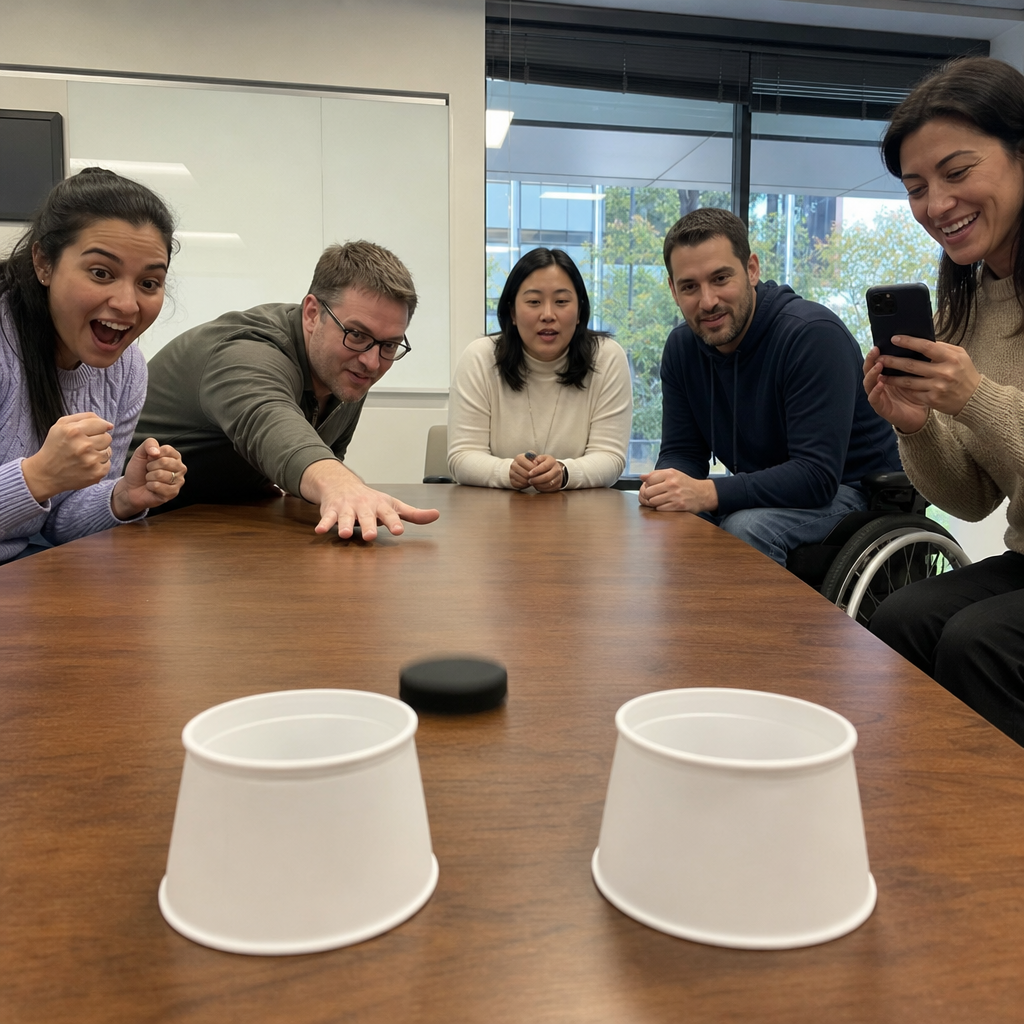
The foam puck stops just short of the cup. Five colleagues lean forward. Someone whispers, “We peaked too early.” Across the aisle, a rival team celebrates a shot that traveled approximately fourteen inches.
This is a corporate sports day with championship-level drama and very little demand for championship-level fitness.
Here is a sample app-based event plan: 80 colleagues, 16 teams of five, six events and 90 minutes. Creativity, tactical judgment and coordination carry as much competitive weight as movement. Nobody needs to run, know sports statistics or appear on camera to help their team win.
It suits mixed-interest departments, company celebrations and offsites where you want friendly competition—not a coached sports session or strenuous workout. Think corporate field day, but with more ways to become the person who saves the round.
Each event begins with an app challenge and ends with a photo, video or written submission. Social Scavenger’s supported challenge formats provide that variety; the shared discussion between opening the prompt and submitting is where the game happens.
The opening half: invent, debate, take the shot
The Photo-Finish Upset
The app asks for a sports-page photograph of a wildly unlikely champion. The sport must be recognizable, an everyday object must win, and the picture must tell the story without a caption.
A small houseplant has won the cycling final. Seated teammates mime handlebars and stare at its triumph. Someone suggests a tighter crop: less conference-room carpet, more sporting injustice.
Teams have eight minutes to choose their sport, arrange the scene and submit one photograph. The entertaining decision is how to make the upset instantly readable—not who can strike the biggest pose.
This makes a welcoming opener for mixed departments: an inventive suggestion can matter more than confidence in front of a camera. Everyone can remain seated. Camera-shy colleagues can direct or frame the shot, and props can play every competitor. Those choices carry the same scoring opportunity.
The Ten-Credit Team Talk
Next, the app gives teams fictional competitor profiles, three upcoming events and ten credits to recruit a three-person lineup.
Do they spend six credits on a straight-line specialist and fill the remaining places with two two-credit rookies? Or choose three adaptable competitors costing three, three and four credits? The expensive star is impressive—but the schedule includes precision and baton exchanges, not just speed.
Teammates compare the supplied strengths, agree on a lineup and submit their choices with a short explanation of the trade-off. No real-world sporting knowledge is needed.
This round suits analytical and cross-functional groups. Its pleasure is the sudden seriousness with which sensible adults defend an imaginary recruitment decision. Everything works seated, and the colleague who dislikes photographs can now make the argument that changes the team’s plan.
Tabletop Curling, Boardroom Stakes
The app introduces a miniature precision event: slide a soft puck toward a target formed by lightweight cups. An open approach offers a straightforward shot; a narrower approach demands more control.
The team chooses a line, tries it, discusses what happened and adjusts. Its app submissions are a photograph of the final position and a short written explanation of the adjustment. Planning and learning count alongside the result.
This is the round for people who want something tangible to happen. A tiny miss can generate enormous commentary, especially when the neighboring team is also treating two cups like an international arena.
Use matching equipment and surfaces, with comfortable seated reach. Participants can slide, select the angle or diagnose why the first attempt drifted. Choosing the correction is a competitive contribution—not a consolation role for someone who is not taking the shot.
The second half: challenge the replay, find the rhythm, call the comeback
Replay Rebellion
A disputed mascot relay arrives in the app. The finish-line view suggests one winner, the baton handoff raises a question, and an overhead view changes the apparent order.
With the short relay rule supplied, teammates compare the replay evidence. Encourage each person to examine a different detail before discussing the whole sequence. They submit a verdict and identify the observation that settled it.
The satisfying moment is not remembering an obscure rule. It is hearing, “Wait—the mascot crossed, but where was the baton?” and watching the group reconsider its confident first answer.
This suits puzzle-minded teams and colleagues who prefer noticing to performing. It works entirely seated. Include equivalent written descriptions with the images and labels that do not rely on color alone. Save the decisive replay detail for the closing reveal.
Synchronized Sitting
The app asks for a 15-second sporting routine with three coordinated moments, a deliberate pause and an unexpected finish.
A seated rowing start becomes slow-motion archery, freezes for one dramatic beat, then ends with the smallest victory salute imaginable. The team choreographs, rehearses and uploads one short video.
The joke is the gap between “we all know when to move” and what actually happens on the first attempt. Coordination matters; polished dancing does not.
This round suits playful groups, while leaving substantial work for sequence designers, directors and camera operators. Hands or lightweight props can carry the entire routine. Nobody has to stand, speak or show a face, and a prop-only performance competes on the same terms. Keep movements within each participant’s comfortable range.
The Comeback Broadcast
The final app prompt turns an earlier mishap into sporting history: write a three-sentence broadcast describing a setback and recovery, credit an unexpected contributor, and include one extravagant sporting metaphor.
“Our medal hopes were sliding toward the edge of the table. Then Jo spotted the gentler angle. A dynasty was born between two cups.”
Teams submit the text, and the host reads selected entries during the finish. Nobody needs to deliver a live performance.
This is particularly useful for mixed-confidence groups: writers, observers and people who remember the small turning points get the final competitive say. It also gives the championship a human ending. The person who quietly rescued the photograph can receive the kind of commentary normally reserved for a winning goal.
A championship for 80—not six queues
Keep the 16 teams at accessible team bases rather than rotating 80 people through six physical stations. Give each base the same tabletop equipment and enough space for photography and comfortable movement. Teams play the rounds in parallel, submit through the app and move on together.
Each event occupies nine minutes: approximately eight for the task and one to reset. The break and closing ceremony are part of the 90 minutes, not extras squeezed in afterward.
| Elapsed time | What happens | Minutes |
|---|---|---|
| 0–10 | Welcome, app entry and participation briefing | 10 |
| 10–37 | Photo finish, team selection and tabletop curling | 27 |
| 37–45 | Break | 8 |
| 45–72 | Replay, synchronized routine and broadcast | 27 |
| 72–90 | Finish judging, share highlights and reveal results | 18 |
That sequence is a meaningful part of professional event design: visual invention gives way to discussion, then hands-on action. After the break, attention shifts to evidence, coordination and storytelling. The same confident performer should not be carrying all six rounds.
Make the scoreboard match the promise
Give every event a ceiling of 100 points: 600 available overall. Keep that ceiling unchanged for seated and prop-only participation. Award no extra points for distance, physical intensity or submitting first.
Put the relevant judging criteria in each app prompt: brief fit and invention for creative work; evidence and reasoning for tactical decisions; planning, adjustment and outcome for the precision event. Two different recruitment choices can both score well when the reasoning supports them.
Social Scavenger’s scoring features support configurable challenge values, content judging and leaderboard standings. Include human review in the event scope and have it happen during play—not begin when all six rounds are over. Creativity is not something to leave to an assumed automatic score.
Keep special recognitions separate from championship points. Best recovery or sharpest observation can celebrate contributions without changing the competition after everyone has finished.
Before the opening whistle
Check participation with people, not just the venue brochure. Ask privately about access needs, then inspect entrances, surfaces, restrooms, seating, table clearance and routes between team bases. Arrange a quieter space and assistance where needed. Test the actual device and app participation arrangements with the people who will use them.
The Government of Canada’s inclusive-event guidance supports participant consultation, direct venue checks, breaks and recording permission. Explain where submissions will be shown, shared and retained; obtain consent before photographing people. Offer behind-camera and prop-only participation from the outset, without asking anyone to explain their preference publicly.
Keep the physical demands modest and the weather plan real. Use lightweight props, with no climbing, lifting colleagues or running with phones. For outdoor play, provide water and shade, name the weather decision-maker and identify safe shelter and stopping procedures. The National Weather Service’s lightning guidance calls for monitoring, shelter and resumption arrangements; a small rain shelter is not adequate lightning protection.
Social Scavenger’s custom games provide the relevant starting point: themes and challenges can be tailored, and selected challenges can appear at scheduled times. Ask for the experience you want, including judging and the closing highlights. Hosting, equipment and venue responsibilities should be explicit; the event-ownership guide helps separate those jobs.
You can send this brief with your date, location and budget range:
We have 80 colleagues and want a 90-minute app-based sports day in 16 teams of five, with no mandatory running or on-camera performance. We want six equally weighted events: a creative sports photo, a tactical lineup decision, tabletop precision, a collaborative replay puzzle, coordinated video and a written comeback broadcast. Please quote the custom build, event support, human judging and closing highlights. Clarify equipment, device and connectivity arrangements, access support, on-site hosting and venue responsibilities.
Give the host time to tell those small stories at the finish. The cup-width miss, the quiet correction and the houseplant’s improbable cycling victory deserve a replay, too.