

 Amazing Race
 Choose Wisely
 Unlock the Box
 Mall Hunters
 Mission Impossible
 The Great Charity Race
 Clues to a Mystery


 Random Acts of Kindness

 Where in the World is the Crystal Snow Globe?
 The Big Escape
 Team Trivia
 The Feud
 Summer Olympics
 Winter Olympics
 Who Kidnapped Santa?





Choose who owns the work before choosing a team building agency. The deciding question is not whether you want an app-based game. It is whether you need someone to coordinate the whole gathering—or deliver one well-defined part of it.
- Agency-led: Request whole-event coordination when venues, suppliers, schedules, and local staffing need one accountable lead. Your company still owns its objectives and approvals.
- Specialist-led: Buy game preparation and the agreed delivery support when someone already owns the surrounding event. Your team retains venue and supplier coordination.
- Organizer-led: Manage a prepared app-based experience internally when you have someone available to organize participants and run the room. Self-managed does not mean building a game from scratch.
An app is a delivery tool, not a staffing plan. A game producer, remote support team, onsite host, and whole-event coordinator do different jobs. An agency and a game specialist can also work within the same event plan.
A completed ownership matrix: what stays with you?
These are recommended allocations for scopes you can request—not standardized package inclusions. The agency column assumes whole-event coordination; the specialist column assumes live remote game support with an internal room lead; the organizer column assumes a provider-prepared app game.
“Buyer” means your company. Replace role titles with names before booking; one person may hold several roles.
| Work to assign | Agency-led event | Specialist-led game | Organizer-led app game |
|---|---|---|---|
| Objectives and internal approvals | Buyer sponsor | Buyer sponsor | Buyer sponsor |
| Master schedule and non-game suppliers | Agency event lead | Buyer event lead | Buyer event lead |
| Invitations and participant information | Buyer communications lead | Buyer communications lead | Buyer communications lead |
| Game preparation and digital results | Game provider; agency tracks milestones | Game provider | Game provider |
| Venue booking, access, and readiness | Agency venue lead | Buyer venue lead | Buyer facilities lead |
| Game-asset receiving, installation, and removal | Agency setup lead | Buyer setup lead | Buyer facilities lead |
| Local gathering, kickoff, and finale cues | Agency’s booked room host | Buyer room lead | Buyer room lead |
| Live gameplay coordination | Booked game facilitator | Contracted remote game team | Buyer room lead |
| Game-platform support | Provider’s agreed support contact | Provider’s agreed support contact | Provider’s agreed support contact |
| Venue Wi-Fi, AV, and device-readiness checks | Agency technical lead | Buyer technical lead | Buyer technical lead |
| Company-content approval | Buyer content approver | Buyer content approver | Buyer content approver |
| Purchased customization production | Game provider | Game provider | Game provider |
| Private accommodation intake and plan acceptance | Buyer access lead | Buyer access lead | Buyer access lead |
| Coordinating agreed participation arrangements | Agency event lead | Buyer access lead | Buyer access lead |
| Schedule changes and contingency coordination | Agency event lead within agreed authority | Buyer event lead | Buyer event lead |
Do not accept “setup included” as a complete assignment. The provider may prepare the digital game while facilities installs physical assets and IT checks the screen. Each handoff needs an owner, finished deliverable, deadline, person accepting the work, and escalation contact. Keep venue emergency procedures separate from ordinary event-change decisions.
Three sample event plans—and where the work lands
30 people in the office: keep coordination close to the room
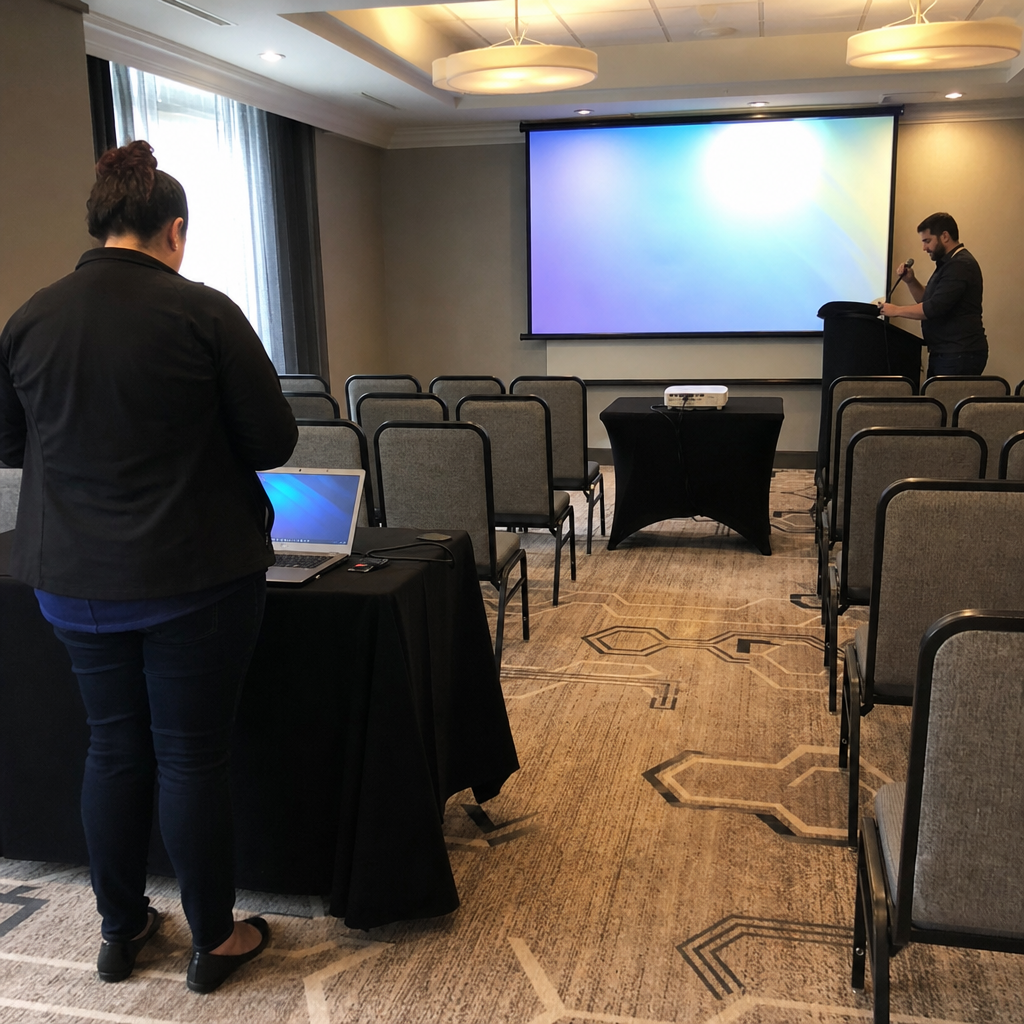
Assumptions: The room is booked, a 90-minute slot is available, and one internal coordinator has brief facilities and IT support. No transport or outside catering needs coordination. The unresolved work is preparing the game, setting up the room, and leading the session.
Choose an organizer-led prepared poster game. Teams scan a poster’s QR code, open an app challenge, compare interpretations, and submit their response before continuing. Digital standings and an instant slideshow provide the shared finish. Social Scavenger prints and ships the game posters; your team displays them.
- Planning and facilitation: The internal coordinator owns invitations, team arrangements, and timing, then cues the supplied introduction and wrap-up described in the poster-game walkthrough.
- Venue and technology: Facilities receives, installs, and removes posters in approved locations. IT checks connectivity, screen, and sound. The provider prepares the agreed digital game and supplies the contracted support.
- Customization and contingencies: One buyer approves company material; the provider produces purchased customization. The coordinator handles late arrivals and room or schedule changes, escalating game issues to the agreed support contact.
An agency would add another handoff without resolving much under these assumptions. The organizer needs a prepared experience and a ready room—not another whole-event coordinator.
150 people celebrating: separate game support from local hosting
Assumptions: A hotel, dinner, and internal celebration coordinator are already in place. An afternoon is available for a city hunt. The missing pieces are game delivery and someone to lead the kickoff and reveal while the organizer participates.
Choose specialist-led delivery with an explicitly booked onsite host. Social Scavenger’s city-hunt service layers distinguish producer preparation and game-day support from the live remote team in Premier and Gold. An onsite host for kickoff and reveal is a separate add-on.
- Planning and facilitation: The buyer coordinates the celebration schedule and dinner handoff. The game producer prepares the hunt. A Premier remote team handles its live game scope, including human creative judging; the separately booked onsite host leads the agreed kickoff and reveal.
- Venue and technology: The buyer coordinates gathering points, hotel access, route suitability, local AV, and participant readiness. The provider supports the game—not the hotel’s internet or dinner service.
- Customization and contingencies: One buyer supplies and approves company content. The buyer event lead owns the weather decision and participant communications, with the provider contributing the agreed game arrangements.
These purchases solve different problems. A team can debate an approach to a photo challenge, submit its image through the app, and have its creativity assessed by remote judges. That does not put someone beside the hotel microphone.
Agree on weather arrangements before the date. The city-hunt page describes possible rescheduling and an advance indoor backup where available—not an automatic same-day switch. Name who secures the alternative space, makes the decision, and tells attendees.
500 conference attendees: connect the game to the master plan
Assumptions: A venue is reserved for a two-day conference, several suppliers are involved, and no internal production lead has capacity to coordinate them. An indoor app-game session needs to fit the wider agenda; setup windows and supplier handoffs remain unresolved.
Choose agency-led coordination with a specialist game scope. A poster-based app game is one format to assess: Social Scavenger advertises 20 to 600-plus players, but that does not establish whether your room has suitable circulation, sightlines, or access.
- Planning and facilitation: The agency event lead owns the master schedule. Its booked room host handles announcements and stage cues; the game provider delivers the agreed game operation.
- Venue and technology: The agency coordinates access, asset installation, local staffing, and removal. Its technical lead coordinates venue AV and connectivity; the game provider owns its digital scope.
- Customization and contingencies: The provider produces approved game content. The agency coordinates schedule changes within buyer-approved authority; venue personnel lead emergency procedures.
The buyer retains objectives, attendee information, internal approvals, accommodation intake, and company-content approval. Social Scavenger’s conference services include development assistance and additional game-operation services; that is a game scope, not whole-conference production.
Change one assumption and the recommendation changes: if an established conference producer already owns these handoffs, add the game specialist to that plan. Do not appoint a second coordinator for the same work.
Buy coordination where it is missing—not because the group is large
An agency earns its place when it takes responsibility for unresolved dependencies: venue access, supplier timing, transport, room readiness, and changes affecting several parts of the day. It adds unnecessary complexity when every decision simply passes through another inbox before reaching the person already responsible.
Headcount is not the rule. A small offsite with an undecided venue and multiple travel arrangements may need more coordination than a large conference with an experienced production team.
Professional game design is a separate purchase. Ask who will fit the challenge mix to the audience, make instructions clear, protect time for the finale, and agree how recognition works. For example, a celebration brief might prioritize creative submissions and a shared reveal rather than adding company trivia that only long-serving employees can answer.
Give participation planning an owner, too. Government of Canada guidance recommends early accommodation input and checking the actual venue. Ask how colleagues can contribute through solving, interpreting, planning, photographing, or submitting within the app-based experience without requiring everyone to perform on camera.
Questions that expose unassigned work
Ask these before accepting a scope described as “managed”:
- Who opens the room and confirms setup is finished?
- Who receives, installs, and removes game assets?
- Who is physically present to gather people and use the microphone?
- Who handles game questions—and who handles venue internet problems?
- Who checks agreed accommodation arrangements before participants arrive?
- If the preceding session runs late, who authorizes changes and protects the finale?
- Who tests the reveal on the actual AV system?
- Which tasks remain with us after booking?
Copy this scope-of-work email
Subject: Confirming event ownership and delivery scope — [date], [group size]
Hi [name],
We are planning an app-based team event for [number] colleagues in [location] on [date]. Our goal is [goal], our available time is [window], and our venue status is [confirmed / still needed]. Our internal event contact is [name].
We are considering [whole-event coordination / specialist game delivery / an organizer-led prepared game]. We will own company objectives, attendee information, internal approvals, accommodation intake, and approval of company content.
Please confirm the owner, deliverable, deadline, and approval point for planning, game preparation, facilitation, venue/setup, technology checks, customization, and contingencies. Identify what is included, optional, excluded, or dependent on us.
Please distinguish producer preparation, live remote support, and onsite staffing. Who runs the kickoff and reveal? Who receives and installs assets? Who checks venue connectivity and AV? Who coordinates schedule changes, weather alternatives, and technical escalation?
Please list the inputs and approvals you need from us, their deadlines, event-day contacts and support coverage, and any unresolved responsibilities.
Thanks,
Choose the arrangement that leaves no important task without an owner—not the one with the broadest label. Once those handoffs are clear, compare the relevant package and quote.