
 Amazing Race
 Choose Wisely
 Unlock the Box
 Mall Hunters
 Mission Impossible
 The Great Charity Race
 Clues to a Mystery


 Random Acts of Kindness

 Scavenger Hunt From Home
 Where in the World is the Crystal Snow Globe?
 The Big Escape
 Team Trivia
 The Feud
 Summer Olympics
 Winter Olympics
 Who Kidnapped Santa?




Picture a team solemnly debating a refund for an invisible umbrella that arrived in the wrong color.
“How can anyone prove it’s yellow?”
“The dispatch record says yellow.”
They are drafting a request for the customer to return it when someone rereads the policy: physical returns are required for visible goods only. The return request disappears. The umbrella, of course, was already invisible.
That is a useful starting point for funny group games at work: give colleagues an absurd situation worth defending, rather than telling anyone to be entertaining.
Here are two sample custom Social Scavenger experiences. Choose Literal Instructions for visual jokes made with tabletop objects, or The Appeals Desk for camera-free discussion and deadpan writing. Allow about 20 minutes for the photo session, 25 for the appeals session, or 40–45 for both, after access is ready.
In either format, teams open a challenge in the app, compare interpretations, agree on one photo or text response, submit it and continue. Social Scavenger supports both photo challenges and free-form text submissions.
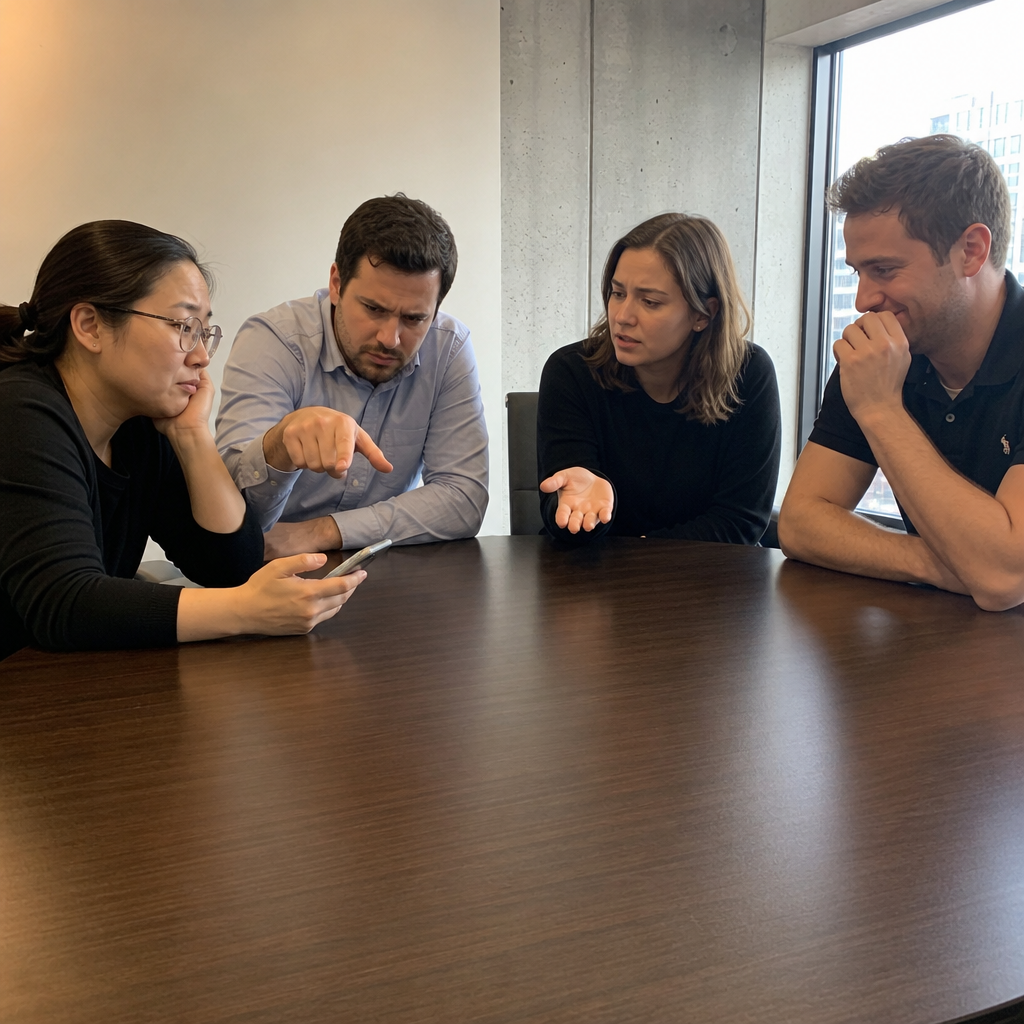
The Appeals Desk: ridiculous evidence, reasonable rulings
The negotiation happens inside each team—not between an employee playing an angry customer and an unfortunate colleague playing customer service.
Someone can defend the requested remedy. Someone else can test it against the evidence. Another person can find the sentence that changes everything. Nobody needs an accent, a costume or a microphone.
Case one: the invisible umbrella
The team receives this complete case in the app:
THE INVISIBLE UMBRELLA
Complaint: “I ordered an invisible cobalt-blue umbrella. You sent an invisible buttercup-yellow one. I want a refund.”
Evidence
- A: The receipt specifies cobalt blue.
- B: The dispatch record specifies buttercup yellow.
- C: This model is invisible in every available color.
- D: Desk policy allows a refund or replacement for a color mismatch. Physical returns are required for visible goods only.
Agree on a ruling. In no more than three sentences, acknowledge the complaint, use at least two supplied details, and give a remedy plus one practical safeguard against a repeat. Aim for 60 words or fewer. Do not invent evidence or blame the customer.
Submit one team text response here. You have seven minutes.
One team approves the refund:
Your cobalt-blue order was dispatched in buttercup yellow, so we approve a refund. The return policy covers visible goods only; no physical return is required. Future dispatches must match the color recorded on the receipt.
Another offers a corrected order:
We acknowledge the color mismatch and offer a cobalt-blue replacement for the buttercup-yellow dispatch. Both are invisible, but their records must be distinguishable. Confirm the replacement’s color against the receipt before dispatch; no physical return is required.
The interesting disagreement is not whether invisibility exists. Everyone accepts that. It is whether to honor the requested refund or offer to put the order right. The colleague who notices the return-policy loophole makes either remedy simpler—and changes the final submission without having to deliver a joke.
Case two: the echo that took the last word
THE MISSING LAST WORD
Complaint: “I rented an echo for my farewell speech. You promised I would get the last word, but the echo took it.”
Evidence
- A: The advertisement says, “You always get the last word.”
- B: The service terms say the echo repeats the speaker’s final word exactly once.
- C: The transcript ends: Guest: “Goodbye.” Echo: “Goodbye.”
- D: The service can be switched off before a final line.
The desk may authorize a refund or a replacement session and correct misleading wording.
Agree on a ruling in no more than three sentences. Acknowledge the complaint, use at least two evidence details, and give a remedy plus a prevention step. Aim for 60 words or fewer. Do not add evidence or mock the complainant.
Submit one team text response here. You have seven minutes.
One team finds the promise at fault:
Refund approved: you were promised the last word, but the transcript gives it to the echo. The echo repeated once, exactly as specified; it is cleared of improvisation. Remove the last-word promise from the advertisement before the next booking.
Another preserves the service:
We offer a replacement session, switching the echo off before your final line so you get the last word. The transcript shows one correct repeat, and the service allows that final silence. Change the advertisement to “We repeat; you conclude.”
Now the debate has shifted: did the service fail, or did its promise fail? Both rulings can satisfy the brief. The pleasure is in treating an echo’s contractual obligations with entirely unnecessary seriousness.
Literal Instructions: make the wording visible
This format moves the comedy from language to composition. Teams interpret everyday phrases much too precisely, then submit an object-only photograph in the app.
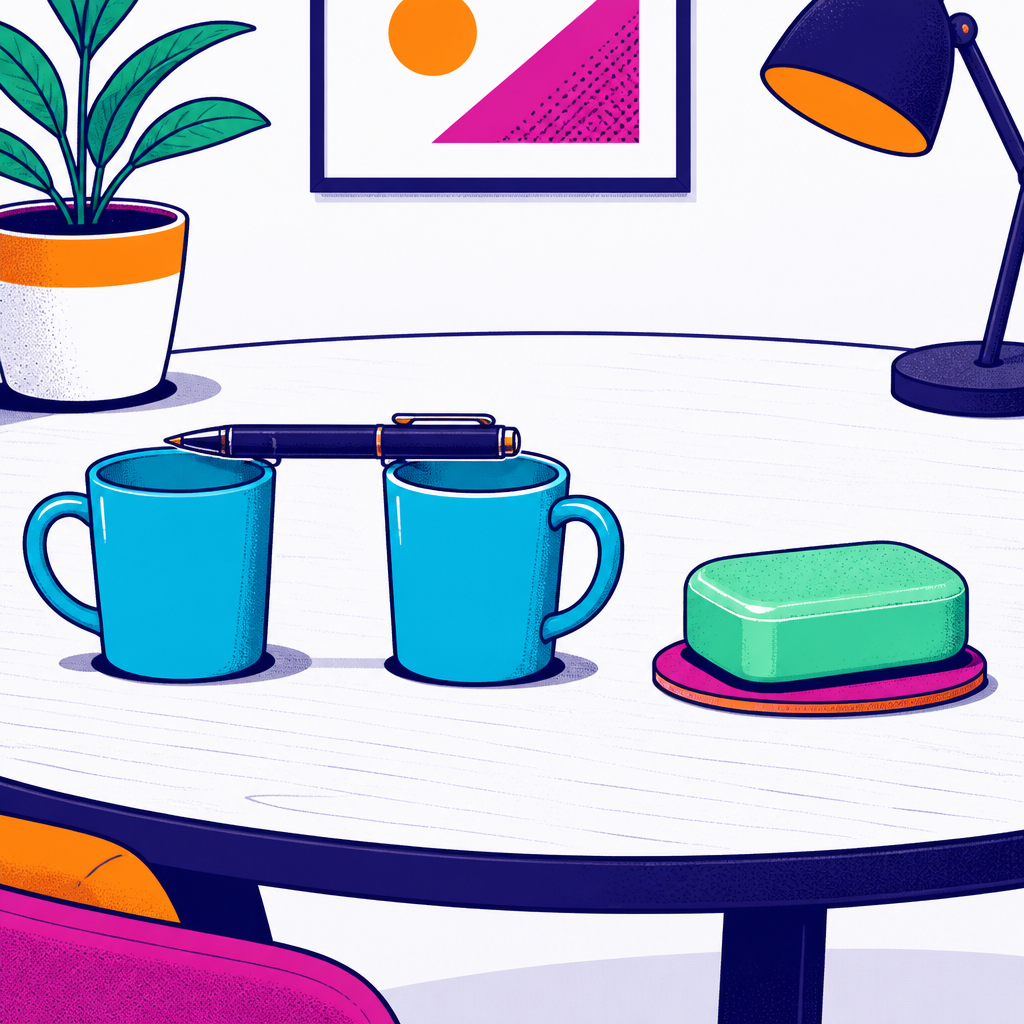
For this sample, use teams of four or five around a shared tabletop. Provide the same small selection of props: empty lightweight mugs, coasters, capped pens, small erasers, a loose unplugged cable and a clean bar of soap. Nobody needs to search the office or contribute personal possessions.
“Keep me in the loop”
KEEP ME IN THE LOOP
This phrase normally means “keep me informed.” Interpret it literally instead.
Choose one small object to stand for “me,” then arrange a photograph showing that object inside a visible closed loop. Keep everything on the tabletop; do not wrap anything around a person. Let the arrangement explain the phrase without an explanatory caption.
Submit one team photo in this challenge. You have five minutes.
One team places a capped pen inside a generous circle made from the unplugged cable. The pen is comprehensively included.
Another starts making the same circle until a teammate says, “It never says we have to make the loop.” They lay an empty mug on its side with its handle flat against the table, then place a tiny eraser inside the handle.
The team changes its composition. The eraser is now fully informed. Both photographs meet the brief.
“Raise the bar”
RAISE THE BAR
This phrase normally means “set a higher standard.” Give us a literal interpretation: choose an ordinary bar or bar-shaped object and show it safely supported above the tabletop.
Stay seated and keep the arrangement low and stable. Do not move furniture or lift a person. Height is not a competition.
Submit one photo without an explanatory caption. You have five minutes.
One team rests a pen securely across two empty mugs, producing an extremely small high-jump arena.
Another is discussing a more elaborate construction when someone places the bar of soap on a single coaster.
“It says raised. It doesn’t say impressively.”
They choose a low camera angle so the coaster is clearly visible and submit their photograph. The minimum compliant altitude deserves exactly as much credit as the pen bridge.
A colleague can choose the interpretation, direct object placement or check the camera view without taking the photograph or appearing in it. Those decisions determine the answer; they are not consolation jobs.
Object-only photography is not a camera-free activity. If the whole group wants no photography, choose The Appeals Desk and keep both cases and responses in the app.
The judges check the brief—not the laughter
Request equal-value challenges with human-reviewed, team-based points in the app. Social Scavenger supports challenge values and human judging; agree who will review submissions as part of the custom-event scope.
- For photos: does the arrangement visibly fulfill the literal instruction within its safety and composition boundaries?
- For rulings: does the response acknowledge the complaint, use the supplied evidence and give a coherent remedy and prevention step within the brief?
Equally valid interpretations receive equal credit. The examples above demonstrate possibilities, not an answer key teams must reproduce.
No bonus for speed, photographic polish, elaborate prose, confident delivery or making the reviewer laugh. Ties are welcome. Otherwise, a session designed to avoid compulsory performance quietly becomes a talent contest.
Turn two rounds into a workplace session
Literal Instructions is the stronger fit for an in-person meeting break with accessible tables and an appetite for arranging objects. The Appeals Desk suits seated offsites, no-camera preferences and distributed teams that enjoy discussing wording.
Use these suggested schedules after joining and device checks:
| Session | Window | Suggested allocation |
|---|---|---|
| Literal Instructions | 20 minutes | 3 briefing + 10 play + 4 reveal + 3 buffer |
| The Appeals Desk | 25 minutes | 3 briefing + 14 play + 5 reveal + 3 buffer |
| Both formats | 40–45 minutes | 3 briefing + 24 play + 8 reveal + 5–10 buffer |
Arrange review during play, with enough coverage for your number of teams. Finish with a few contrasting submissions rather than a presentation from every group.
For remote play, agree team conversation spaces and access beforehand. Most existing Social Scavenger virtual games use browser access with one Tech Captain signing in; confirm the arrangement for your custom session rather than instructing everyone to download an app.
Ask about access and communication needs early, consistent with inclusive event-planning guidance. Read prompts aloud where useful, explain unfamiliar idioms and allow additional reading time when needed. Seated play alone does not resolve every access requirement.
Before submitting, teams should invite another interpretation and read back the agreed response. Someone can influence an appeal by identifying contradictory evidence or refining the remedy without typing or speaking to the whole room. Passing on speaking remains acceptable.
What to tell participants
Your job is to meet an absurd brief, not prove you are funny. Read the challenge together, consider more than one answer and agree what your team will submit in the app. Nobody has to appear on camera, perform or share a personal story. Points recognize following the brief. One useful observation can change the whole answer.
What to send your event producer
Keep customization focused on what teams actually do. These cases do not need coworkers’ names, real customer complaints or jokes about anyone’s competence.
We would like a custom Social Scavenger session using [Literal Instructions / The Appeals Desk / both]. Our group size is [number], setting is [venue or remote], date is [date] and available activity window is [duration].
Please use the selected sample prompts, with photo submissions for Literal Instructions and text submissions for The Appeals Desk. We want seated participation, no required on-camera appearances and equal-value, human-reviewed brief-completion scoring.
Please scope game preparation, facilitation, reviewer coverage, access checks, support and any prop preparation. Agree submission visibility, retention and later sharing with us before the event. We would like to finish with selected contrasting responses, without requiring team presentations or public posting.
At the finish, put the pen bridge beside the soap on its coaster, or read two defensible umbrella rulings. Ask, “Which detail changed your answer?” Let teams explain their choices if they wish.
The refund is approved. The invisible umbrella does not need to come back.