

 Amazing Race
 Choose Wisely
 Unlock the Box
 Mall Hunters
 Mission Impossible
 The Great Charity Race
 Clues to a Mystery


 Random Acts of Kindness

 Where in the World is the Crystal Snow Globe?
 The Big Escape
 Team Trivia
 The Feud
 Summer Olympics
 Winter Olympics
 Who Kidnapped Santa?




Build a worthwhile goose chase around five short app challenges that each earn useful evidence, then finish with one deduction that uses all five. Make misleading clues recoverable, offer hints, and fit the briefing and reveal—not just gameplay—inside your 45 minutes.
A wild-goose chase ordinarily means a futile or drawn-out search. This design reverses that expectation: the distractions have explanations, and the evidence leads somewhere. The joke should be on the misleading clue, not on the player.
The Goose Hasn’t Left the Room: the event brief
A fictional goose is hiding in one of six digital nests. Teams complete five independent missions in any order, collect evidence in the app, and identify the matching nest in a sixth mission. Nothing requires searching another room.
The sample assumes 20–24 colleagues in five or six teams of four, an accessible meeting room, one prepared smartphone per team, a host, and a separate submission moderator.
Social Scavenger offers custom game development. Its documented app features include photo and text challenges, hints, timed availability, scoring, moderation, and leaderboards. Its challenge-design guide explains how completed tasks can reward players with clues.
Use the shared-device tech-captain model: one person submits the team’s agreed responses. Give the other teammates substantive roles:
- Observer/director: notices details and proposes creative approaches.
- Skeptic: checks whether the evidence actually supports the answer.
- Connector: invites everyone’s contribution before submission.
Rotate discussion leadership after two missions; phone handoffs are unnecessary. Before the session, arrange teams, prepare devices, test connectivity, and place an empty mug and spare chair within each team’s usable space. Production and rehearsal sit outside the 45-minute event.
Five opening missions, five useful facts
In this sample game, Deliver every prompt, scene description, hint, submission, evidence reward, and score through the app. Allow four minutes per opening mission. Each opening hint costs 10 points; access and technical assistance are free.
Mission 1: The Loudest Clue Is Not the Best Clue
App setup: An original lobby illustration shows a large golden-goose arrow pointing right and an analog clock with its short hand at 3 and long hand at 12. Include those same details as app text.
The arrow wants your attention. The clock has the evidence. What hour do the clock’s hands show? Enter one digit; do not follow the arrow anywhere.
The observer examines the scene, the skeptic checks which object matters, and the captain submits 3. A correct response earns 100 points and the evidence: “The right nest’s clock shows 3:00.”
App hint: “The short hand gives the hour. The arrow is decoration.” Teams can solve entirely from the text description while seated.
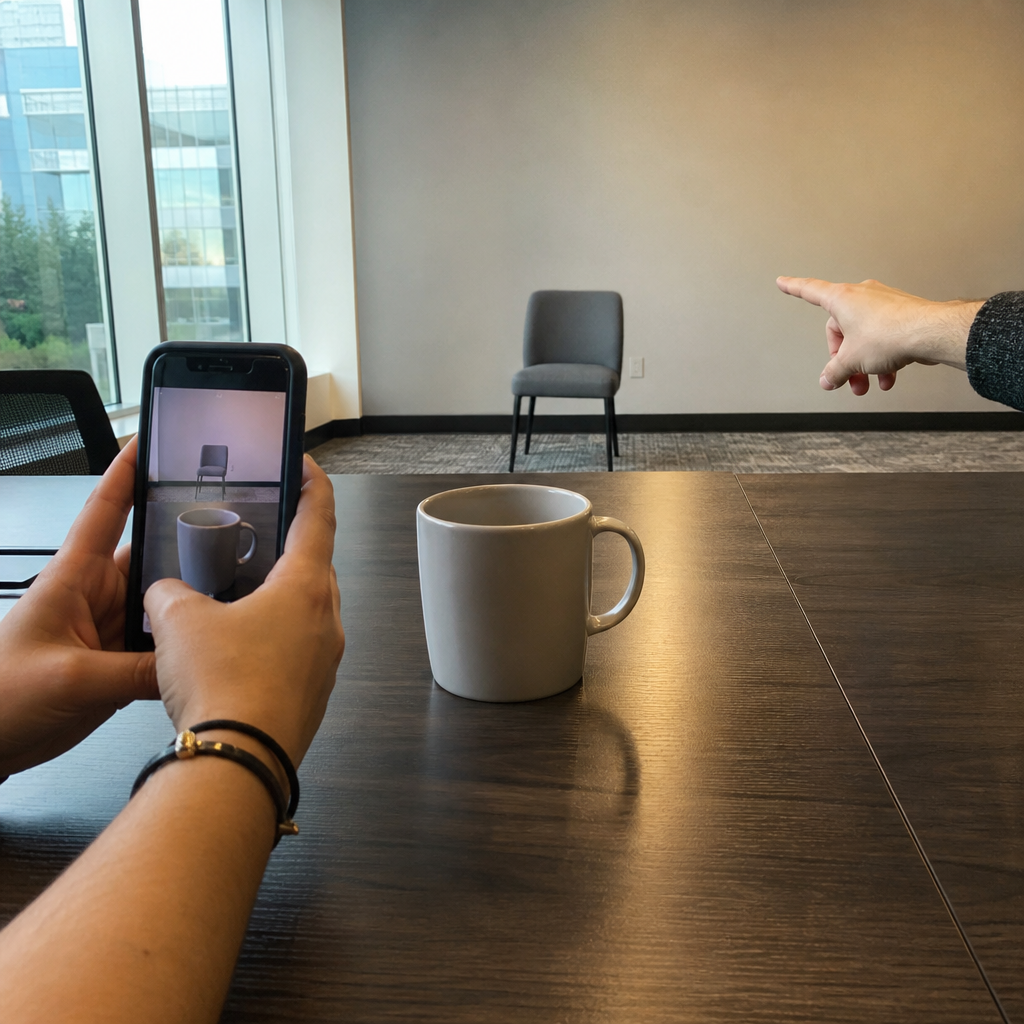
Mission 2: Make a Giant Out of a Mug
Setup: The app delivers the challenge; the mug and chair are ordinary props, not hidden clue carriers.
Use perspective to make a mug look bigger than a chair. Submit one photo with the mug in the foreground and the chair behind it. People need not appear. Work seated or at table height. Do not climb, balance on furniture, or block an aisle.
The director suggests the arrangement, a willing camera operator frames it, and the captain submits through the app. The moderator awards 100 points when both objects are visible, the mug appears larger, and staging respects the safety limits—not for photographic polish.
Evidence reward: “The right nest has a round table.”
Camera-free app version:
Direct the giant-mug illusion without taking a photo. In up to three sentences, explain where to place the mug, chair, and camera, what should appear larger, and how to stage it safely while seated.
A qualifying answer: “Keep the mug on the table close to the camera, with the chair farther behind it. Frame them so the mug appears larger. Everyone stays seated and off the furniture.” The moderator checks positioning, intended illusion, and safe staging. This version receives the same four minutes, 100 available points, and evidence reward.
App hint for either version: “Bring the mug close to the lens and place the chair farther behind it.”
Mission 3: Count the Code, Not the Geese
App setup: Five decorative goose icons, the code 20–23–15, and a complete alphabet key mapping A=1 through Z=26. Present the code and key as text, not only an image.
The geese are decoration. Decode 20–23–15 using the alphabet key. Submit the word it spells; it tells you how many chairs belong at the nest.
A teammate decodes while the skeptic checks the word rather than counting icons. The captain submits TWO for 150 points and the evidence: “The right nest has exactly two chairs.”
App hint: “20 is T, 23 is W, and 15 is O.” No movement or camera is required.
Mission 4: Three Witnesses, One Missing Item
App setup: Show four candidate items—SCREEN, CLOCK, PROJECTOR, MUG—and three labeled witness statements:
- A: “The missing item is not CLOCK.”
- B: “The missing item is not MUG.”
- C: “The missing item is not PROJECTOR.”
Exactly one candidate item is absent from the correct nest. Assign one witness statement to each of three teammates. Explain your evidence to one another. Which item must be missing? Submit its name.
The three readers share exclusions; the captain combines them and submits SCREEN for 150 points. Evidence: “The right nest has no screen.”
App hint: “Eliminate each item a witness rules out; one remains.”
This uses voluntary reading roles on a shared screen, not private app delivery. Everyone may read and revisit all statements together without penalty, including when speech, hearing, or memory access makes that preferable.
Mission 5: The Newest Evidence Wins
App setup: Two fictional records: “09:00 — PLANT REMOVED” in large text and “09:05 — PLANT RETURNED” in ordinary text. Both must remain readable as app text.
A large headline is not necessarily the latest news. Read both timestamps. Which object is back in the nest according to the newest record? Submit the object, not the time.
The observer compares timestamps; the skeptic explains why the earlier headline no longer controls the answer. The captain submits PLANT for 100 points. Evidence: “The right nest contains a plant.”
App hint: “09:05 comes after 09:00; use the later action.” The solution depends on sequence, not color, movement, or photography.
Mission 6: Find the Only Nest That Fits
In the sample schedule, the finale opens to everyone at minute 29, regardless of earlier completion. Allow five minutes. Create six digital scenes with matching text descriptions using the specifications below. All contain an identical mug and projector; no goose is visible yet.
| Nest | Clock | Furniture | Other evidence |
|---|---|---|---|
| A | 12:00 | Round table; two chairs | No screen; plant |
| B | 3:00 | Square table; two chairs | No screen; plant |
| C | 3:00 | Round table; three chairs | No screen; plant |
| D | 3:00 | Round table; two chairs | Screen; plant |
| E | 3:00 | Round table; two chairs | No screen; no plant |
| F | 3:00 | Round table; two chairs | No screen; plant |
Open the evidence you earned. Which nest matches every fact? Discuss why at least one tempting alternative fails, then submit its letter. All nests are in the app; do not search another room.
The connector gathers everyone’s reasoning before the captain submits. F earns 200 points. Each decoy contradicts exactly one clue: A’s clock, B’s table, C’s extra chair, D’s screen, or E’s missing plant. Remove any one clue and its corresponding decoy becomes plausible.
Sample app catch-up hint, 20 points: “Look for 3:00, a round table, exactly two chairs, no screen, and a plant.” This lets teams missing evidence reach the discovery without receiving points for unfinished missions.
Sample completion message: “The goose was never outside. You found the only nest supported by all five facts.”
Keep the scoring in the app—and speed out of it
The sample main-round maximum is 800 points: 100 + 100 + 150 + 150 + 100 + 200. Completing everything with two opening hints gives 780.
Request automatic keyed checks for 3, TWO, SCREEN, PLANT, and F, with accepted variants agreed in advance. Mission 2 requires human moderation within the app experience. Scores remain provisional until review finishes.
The sample rules reward deduction over speed: no speed bonus, one finale answer, and no repeat credit.
An optional tie-break without a fastest-finger advantage
For teams tied at the highest finalized score, deliver this app text task during minutes 36–38:
You could complete the first five missions in any order, using each exactly once. How many different orders are possible? Submit one whole number.
The answer is 120: 5 × 4 × 3 × 2 × 1. Closest wins; equally close answers remain joint winners. Submission speed does not count.
For this sample tie-break, a moderator compares the answers and awards the winner one additional point, bringing the event maximum to 801. Equally close answers share the win.
The complete 45-minute run of show
Here is a sample opening briefing for the app-based experience:
A goose is hiding in one of six digital nests. Your first five challenges earn evidence; play them in any order. Let everyone contribute before your captain submits. Nothing requires leaving this room or photographing a person. Opening hints cost 10 points; the final catch-up hint costs 20. Access and technical help are free. At minute 29, everyone can attempt the finale. Main-round submissions close at minute 34. Points—not running speed—decide the result.
| Event time | What happens |
|---|---|
| 00:00–05:00 | Welcome, briefing, consent reminder, roles, final join check. |
| 05:00–07:00 | Unscored app practice: “Type READY.” Locate instructions and hints. |
| 07:00–29:00 | Five opening missions: twenty minutes plus two for role changes and recovery. Moderator reviews throughout. |
| 29:00–34:00 | Final nest challenge. All main-round submissions close at 34:00. |
| 34:00–36:00 | Regroup; moderator finishes review. |
| 36:00–39:00 | Optional tie-break: two minutes to answer, one to review. Otherwise, recovery time. |
| 39:00–45:00 | Reveal the answer and decoys, announce standings, and debrief. |
Use the closing discussion to ask: “Which clue looked persuasive but wasn’t useful?” and “What did a teammate notice that changed your answer?” Show participant images only with permission.
Plan your custom app-based event
The experience should work seated, with text descriptions of every visual clue and meaningful camera-free participation at full point value. Check actual devices, text sizing, screen-reader behavior where needed, and participant access requirements.
Ask the producer to resolve four operational dependencies:
- Scoring: answer matching, retries, hint deductions, alternative versions, duplicate credit, and the tie-break workflow.
- Evidence: clue availability and visibility. Mission 2’s approval timing must not force a team to purchase a catch-up hint because judging is delayed. Confirm an in-app solution.
- Privacy and timing: keep puzzle answers and rewards hidden from other teams; release the finale at minute 29 and close the main round at 34 without disabling the later tie-break.
- Technical contingency: agree an app-based recovery plan. If connectivity cannot be restored, pause or reschedule rather than improvising a different scoring system.
A ready-to-send inquiry:
We’re planning a 45-minute in-person event for approximately 20–24 colleagues in one accessible meeting room. We’d like to plan a custom six-mission experience based on the example in this article: five independent evidence challenges, a finale at minute 29, a main-round cutoff at minute 34, and an optional app tie-break. Please confirm feasibility, production lead time, quote, host/moderator requirements, equal-value photo/text versions, scoring and clue delivery, answer visibility, and accessible text presentation. Everyone must be able to contribute seated and without using a camera.
Work with your producer to rehearse the complete player journey before event day. Check seated photo staging, text alternatives, clue retrieval, cutoffs, and judging time. If the pilot overruns, simplify the build or revise the schedule—not quietly remove the debrief. The chase should end with “Now I see it,” not “Why did we do that?”