

 Amazing Race
 Choose Wisely
 Unlock the Box
 Mall Hunters
 Mission Impossible
 The Great Charity Race
 Clues to a Mystery


 Random Acts of Kindness

 Where in the World is the Crystal Snow Globe?
 The Big Escape
 Team Trivia
 The Feud
 Summer Olympics
 Winter Olympics
 Who Kidnapped Santa?





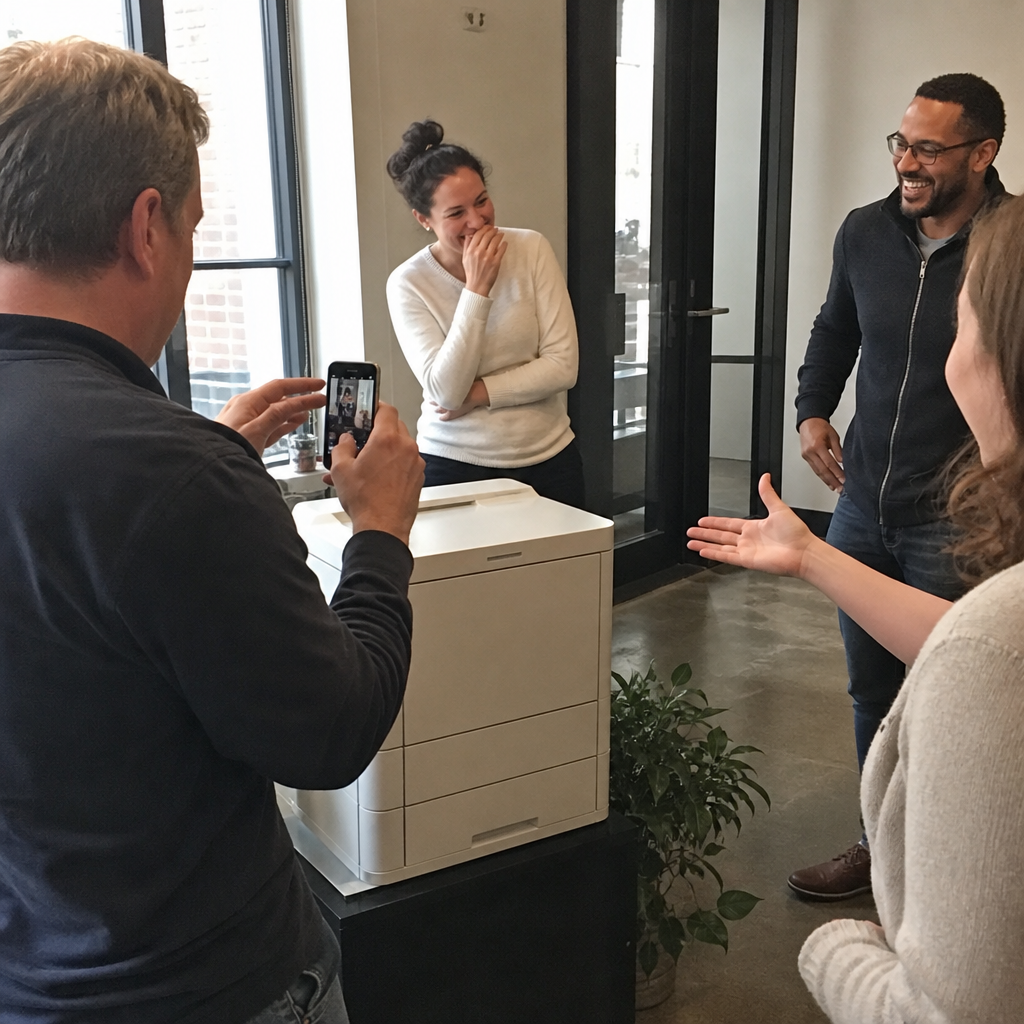
Imagine your office printer accepting Employee of the Month. One colleague films while another delivers its speech: “I’d like to thank Tray Two. We’ve been through a lot.” Someone objects that repeated paper jams should disqualify it. The team’s quietest member supplies the defense: “It’s excellent at creating breaks.”
The office has supplied both the subject and the joke. That’s a useful starting point when searching for team building ideas near you: choose a place your group can use comfortably and with permission, then choose a game that makes that place worth noticing. An impressive address matters less than what colleagues will actually do there.
Below are seven sample missions for a customized app-based event. Teams receive a prompt, agree on an approach, submit their response, and continue to another challenge. Social Scavenger supports photo, video, and free-form text challenges and offers customized games; agree on the challenge mix when booking. Suggested times cover individual missions, not travel or a complete event.
Seven nearby settings—and the experience each makes possible
Office: give an everyday object its moment
The app asks teams to nominate a shared office object for an award and record its 15-second acceptance speech. They must work in two observable details: the coffee machine’s three buttons, perhaps, or the meeting-room chair’s unusually dramatic squeak.
Allow about four minutes for choosing, writing, and filming. A teammate can voice the object without appearing on camera; others write, direct, or frame the shot. Upload the video, then find out what the next app challenge makes you notice about your workplace.
This suits an all-hands break or celebration where another journey would eat into play. The deciding constraint is control of the space: clear communal areas, keep confidential screens and documents out of frame, and avoid interrupting colleagues who are still working.
Park: make a tiny scene feel enormous
For the Six-Inch Safari, the app asks teams to give a small natural detail the treatment normally reserved for a wildlife documentary. A twig becomes a fallen giant. Moss becomes an unexplored forest. The narrator sounds deeply concerned about a leaf.
In roughly five minutes, teammates spot a scene from the path, compose a short video, and upload their miniature epic. Nobody needs to appear in it. Choose viewpoints usable while seated or standing; no collecting, feeding animals, climbing, or leaving paths.
It suits observant teams who enjoy making something together. The first planning question is authorization for the group activity. For example, NYC Parks requires special-event permits for more than 20 attendees and applications at least 21 days ahead. That is a local rule; smaller groups should still check their intended use.
Waterfront: put the skyline in someone’s hand
The app’s Pocket Skyline challenge asks teams to make a colleague appear to hold a distant landmark in their palm. Long sightlines do the work; nobody needs to approach the water.
Allow about four minutes. One person poses, another photographs, and a third directs: “Your hand is holding the wrong building.” The team submits its chosen photo before continuing. The enjoyable moment is getting several people’s tiny adjustments to produce one convincing illusion.
Choose this for a scenic celebration with willing photo participants and useful behind-camera roles. The decisive constraint is a safe stopping point with enough space: confirm the event area, photography requirements, and pedestrian clearance. A narrow promenade is not improved by six teams trying to compose the same shot.
Museum: make the overlooked object the star
The app asks teams to choose an everyday object in an approved gallery and argue why it deserves the headline position in a future exhibition.
Over about six minutes, colleagues compare candidates, read labels, and submit a two-sentence pitch grounded in two label details. Someone makes a surprisingly persuasive case for a cooking pot everyone else nearly passed. The team moves on with a new favorite object—not merely another correct answer.
This suits groups who prefer interpretation and discussion to performance. Use text submissions without photographing exhibits. The deciding constraint is approval for the organized activity, including suitable discussion areas and phone use. ROM’s visitor guidance permits handheld photography for personal use, but that does not establish permission for a corporate game or promotional image reuse.
Campus: translate the local language
“Meet outside B17” means something to a veteran employee and absolutely nothing to a newcomer. The Landmark Translator challenge fixes that—with a little imagination.
The app asks teams to describe the route between two approved outdoor meeting points without building names, department names, or acronyms. In about five minutes, they agree on recognizable landmarks and submit their directions as text. Is that angular building a folded envelope or a giant stapler? A newcomer gets the deciding voice on whether the description makes sense.
This suits orientation and cross-department gatherings. Teams stay together; nobody tests an unfamiliar route alone. The deciding constraint is the approved event footprint: confirm paths and gathering points with the campus operator rather than treating nearby classrooms, laboratories, residences, or offices as playable space.
Shopping center: pack for a business trip to Mars
The app announces an interplanetary work trip. Teams have about five minutes to select two items visible in approved storefront displays: one sensible choice and one ridiculous choice they can defend.
A scarf becomes a diplomatic flag. A suitcase is rejected because someone points out that wheels may not be the priority. Teammates submit the two items and their explanations as text, then continue without buying, borrowing, handling merchandise, or recruiting store employees.
This suits playful debaters who want a sheltered outing. Social Scavenger’s Mall Hunters combines app-based photo and video challenges with puzzles, but property authorization remains separate. Puente Hills Mall expressly prohibits unauthorized scavenger hunts and photography—a concrete reminder that access for shopping is not permission to run a game.
Historic district: file a two-century news report
The app supplies a short, sourced local-history note and asks teams to connect it with a visible detail on an approved block. An old shop sign above a modern storefront could put two eras in the same view.
Allow about six minutes to compare the evidence and submit a two-sentence dispatch: one sentence reporting the historical detail accurately, followed by an imaginative reaction to today’s scene. The careful reader protects the facts; the colleague with a good headline gives the report its voice.
This suits discovery-oriented outings, including groups of locals. The deciding constraint is who controls each stop; a district is not one venue. Confirm the route and keep playful treatment focused on suitable streetscape history, not memorials, sacred spaces, or traumatic events.
Office or waterfront? The same team, two different afternoons
Assume 24 coworkers, a two-hour slot beginning and ending at the office, a reserved office room, and a waterfront requiring a 15-minute walk each way. Here is how that choice changes the event.
| Decision | Office | Waterfront |
|---|---|---|
| Main appeal | Familiar-object comedy | Visual discovery and a change of scene |
| Time at the setting | 120 minutes | 90 minutes after transfers |
| Participation check | Actual room, circulation, and seating | Actual route, surfaces, distances, and rest stops |
| Approval to resolve | Facilities, security, and filming areas | Operator’s event and photography requirements |
| Main disruption risk | Interrupting normal work | Weather and public foot traffic |
Both time allowances still need to include briefing and a shared finish. Choose the waterfront when the journey and scenery are part of the appeal and the route and permissions work. Choose the office when transfers, walking requirements, or unresolved approvals would crowd out the game. Neither setting is automatically more accessible—or cheaper.
Ask participants privately about their needs, then assess the actual site, including entrances, restrooms, seating, sensory conditions, and transport. That follows Government of Canada inclusive-event guidance. Keep appearing on camera optional. A prearranged camera-free waterfront challenge could ask teams to submit a skyline postcard in text using two visible details. Adapt the shared experience rather than leaving someone behind.
Decide how creative work will count, too. In Social Scavenger’s Ultimate City Scavenger Hunt, Classic includes digital standings and a slideshow; Premier and Gold add live remote creative judging. Discuss recognition within your selected game rather than assuming every submission receives automatic creativity points.
Keep the discovery—and the shared finish—when it rains
A good indoor fallback is another experience, not an outdoor route squeezed into a lobby. Reserve suitable space and choose the alternative game before event day.
Social Scavenger’s interactive poster games preserve exploration in a contained setting: teammates inspect clues in venue posters, scan QR codes, solve puzzles, and submit photos and videos through the app. Standings and an instant slideshow bring everyone back together. Published game spaces include office boardrooms and a tech-company campus.
The posters are shipped ahead, and your team displays them; agree on placement and setup responsibilities. The poster-game walkthrough shows the format in more detail.
For an outdoor City Hunt, share your city and preferred area so the team can assess a game zone or discuss a custom one. Its weather guidance specifies advance planning for an indoor backup where available—not an automatic same-day relocation.
Take two places to the planning conversation
Bring a preferred setting and an indoor alternative, with the exact site, date, headcount, door-to-door time window, participation needs, and desired mood. Treat visitor access, group admission, event authorization, and photography as separate questions:
- Who can approve the game, and which spaces are excluded?
- Are the proposed phone use, recording, and finale gathering permitted?
- What customization and backup arrangements are included in the game scope?
Choose the place that gives colleagues something worth doing together. Sometimes that is a skyline. Sometimes it is an overlooked museum object. And sometimes the most promising candidate is already downstairs, complaining about Tray Two.