


 Amazing Race
 Choose Wisely
 Unlock the Box
 Mall Hunters
 Mission Impossible
 The Great Charity Race
 Clues to a Mystery



 Random Acts of Kindness


 Scavenger Hunt From Home
 Where in the World is the Crystal Snow Globe?
 The Big Escape
 Team Trivia
 The Feud
 Summer Olympics
 Winter Olympics
 Who Kidnapped Santa?






“It can’t be a farewell tour if it keeps coming back.”
From the promenade, one colleague watches another wave arrive. Another checks the team’s headline: SURF ANNOUNCES FINAL APPEARANCE.
“Exactly,” someone says. “That’s the story.”
For team building at the beach without swimming or athletic contests, give colleagues a newsroom assignment. Here is Beachfront Newsroom, a sample plan for a custom Social Scavenger app-based experience: teams receive editorial commissions, notice real coastal details, submit dispatches and choose their strongest story for a shared front-page reveal.
It suits a retreat break where making something together sounds more appealing than playing sports. The plan below covers 24 colleagues in six teams of four, with three assignments and a complete one-hour outing. The beach supplies the material. Colleagues supply the interpretation.

Your assignment: bring back three kinds of story
The newsroom has one rule: every dispatch needs a real observation and an imaginative interpretation. Parallel ridges in sand are the observation. The beach launching a corduroy collection is the interpretation.
Social Scavenger supports photo and free-form text challenges. Teams open each commission in the app, discuss their response, submit it and continue. No local-history knowledge or polished comedy performance is necessary.
The visual story: make us see what you saw
Allow nine minutes.
Find a small coastal scene that deserves a front-page picture: a pattern, contrast or tiny apparent drama. Agree on the story. Submit a photo here, then use the separate text commission for your headline and a short description. Stay within the agreed area and leave everything in place.
A teammate spots ridges across the sand. Another notices the railing’s shadow cutting across them. The photographer tests a tighter frame; suddenly, the scene looks less like “some beach” and more like an extremely large pair of trousers.
BEACH DEBUTS CORDUROY LOOK. Fine parallel ridges cross the pale sand; the railing adds one dark stripe. The new collection is strictly outdoor wear.
The enjoyable decision is what to leave out so everyone else can see the joke. For a no-photography version, arrange a text commission asking for two visible details and a headline. The dispatch above works without an image because its description does the framing.
The sound desk: give the coast a headline
Allow nine minutes.
Pause in the agreed spot and notice a coastal sound or repeating rhythm. What would it be announcing if it thought it was important? Submit a headline and a sentence describing what you actually noticed.
The team hears a crash, a long hiss, then another crash. Is that applause? An announcement? An unusually indecisive goodbye?
SURF ANNOUNCES FAREWELL TOUR; RETURNS FOR ENCORE. We heard a crash, a long hiss and another crash. Retirement appears to be going poorly.
Someone’s first suggestion might be “the sea is clapping.” A colleague’s objection—“But it never stops”—creates the better story. No recording is needed. Teams can use a teammate’s description or a visible rhythm, such as successive waves or a moving flag, rather than requiring everyone to hear.
The food column: a seagull reviews the view
Allow nine minutes.
You are an imaginary seagull restaurant critic reviewing this stretch of beachfront. Base your short review on two things you can actually observe: seating, shade, a sea view or closed bins, for example. Submit your verdict on the setting as text.
One colleague wants luxury-travel language. Another points out that a gull would consider secure bins a serious service failure.
Excellent sea views and an entire row of benches. Every bin has a lid. A beautiful dining destination with a deeply troubling commitment to security.
The joke comes from the narrator’s priorities, not from mocking a real business, employee or diner. No bird, purchase, tasting or restaurant visit is required.
Across all three commissions, gather observations, not souvenirs: leave natural objects where they are, and do not feed, approach or disturb wildlife. Keep identifiable bystanders out of submissions. Nothing requires water entry or strangers’ participation.
The editorial meeting decides what everyone sees
Now the team has a picture, a headline and a character with questionable dining standards. Only one gets the lead.
Allow eight minutes for this final text commission:
Choose your lead story. Submit its headline, the observation behind it and one sentence explaining why the rest of the group should see it.
The photo editor champions the sand pattern. The gull review gets the biggest laugh. Someone else argues that everyone encountered the waves, making the farewell tour the most recognizable story. Invite preferences before deciding; holding the phone does not confer editor-in-chief status.
Lead: SURF ANNOUNCES FAREWELL TOUR; RETURNS FOR ENCORE.
Observation: Repeated crashes followed by a long hiss.
Why it leads: We all recognized the rhythm, but had three different ideas about what it meant.
The first edition of The Beachfront Bulletin is a facilitated reading of those six chosen stories, with selected photos shown in the display arrangement agreed for the event. Each team gets up to one minute. A willing teammate—or the facilitator—reads the submitted text from a phone.
This shared front page is the group’s collection of interpretations. Compare what different teams made of the same surroundings, then ask: “Which real detail changed your story?”
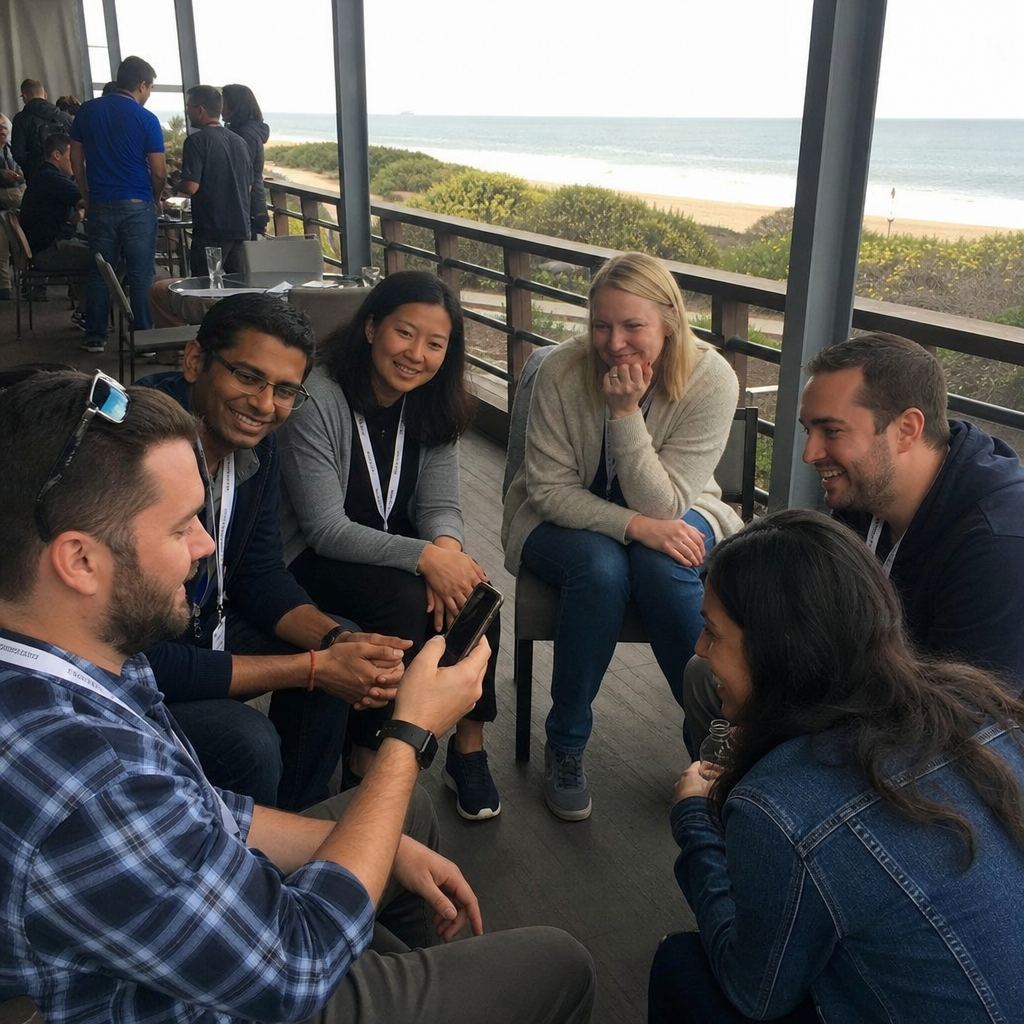
One hour, from first assignment to first edition
Arrange arrival and app access before this activity window. Keep the observation area compact enough that searching does not consume the writing time.
| Time | What happens |
|---|---|
| 0–8 minutes | Welcome, introductions, boundaries, contribution options and the wave example. |
| 8–17 minutes | Visual story: notice, frame, discuss and submit. |
| 17–26 minutes | Sound or rhythm headline. |
| 26–35 minutes | Imaginary seagull review. |
| 35–43 minutes | Editorial meeting and lead-story submission. |
| 43–48 minutes | Regroup and water break, or a seated pause. |
| 48–60 minutes | Two minutes to settle, six one-minute readings and four minutes of discussion. |
Request equal total completion credit for each commission in the app, whether delivered through the agreed photo-and-text or text-only route. Social Scavenger supports assigned challenge point values. Leave speed and distance bonuses out of this brief; recognize excellent observations during the reveal instead.
Water and rest should remain available throughout. If movement or participation needs more time, extend the event rather than cutting the editorial meeting. More teams also need a longer reveal or an agreed selection—not twenty supposedly one-minute readings squeezed into six minutes.
Choose the view you can actually work from
The best site is not necessarily the most dramatic stretch of sand. It is somewhere the whole newsroom can notice, converse and submit comfortably.
Choose a short promenade when exploring is part of the appeal. Inspect surfaces, slopes, crossings, passing space, seating and return time. Teams should stop clear of through-traffic to read and submit, not walk while looking down at phones.
Choose a seated beachfront base when sustained movement would limit participation. A permitted terrace or firm-surface gathering area can keep the whole team together. Check the view from seated height: are there several useful details, or only a wall? Fewer changing views mean more discussion time, but the base still needs material worth noticing.
A seated teammate can challenge the headline’s logic, shape the critic’s voice, select the lead or submit the agreed response. Do not send everyone else exploring while leaving that person to guard bags.
Choose another location when access or exposure undermines the outing. Loose sand is not equivalent to a firm, stable route—a distinction reflected in the US Access Board’s federal beach-access guidance. Inspect the full journey from arrival to toilets, gathering area and finish; a beach-access sign alone does not establish suitability.
Ask privately about mobility, sensory and app-use needs. Reading prompts aloud and describing details can help colleagues influence the same submissions. For a fully camera-free outing, request that arrangement from joining through gameplay before setup. A seat and a text option are not blanket accessibility guarantees.
Two decisions to settle before invitations
Can you use the site for this event? Describe the organized app game, headcount, gathering footprint, photography and equipment to the land manager. Public access is not event permission: New York City and Toronto, for example, have local event-permit processes. Your location’s rules govern your outing.
Can teams receive and submit their work? Test an actual sample app challenge at the playing area and finish using the expected devices and connections. If delivery is unreliable, choose a better-connected location.
Agree where the newsroom goes if conditions change
Check shade at the intended hour, drinking water and somewhere to pause. Heat alerts may warrant postponing or avoiding outdoor activity; shade does not make severe heat acceptable.
Name a weather decision-maker and identify reachable lightning shelter for everyone. At thunder, stop and move to a substantial building or enclosed hard-topped vehicle—not an open beach shelter. National Weather Service guidance calls for at least 30 minutes after the last thunder before resuming. For this one-hour outing, that may mean ending rather than rushing to restart.
Dry-land participation is a design choice, not a safety guarantee. Dangerous waves can reach apparently dry beach areas. Set boundaries using current local warnings and land-manager guidance, away from surf exposure, unstable edges and closed areas. No photograph justifies a closer approach.
Agree on a booked alternative location, who makes the switch and how participants will hear. A coastal-view room can retain visual observations and visible rhythms. If the alternative has no coastal connection, arrange a different app-based brief beforehand rather than pretending the beach story transfers unchanged.
Send a brief with an ending in it
Use this inquiry to describe the experience, then separate game preparation, on-site facilitation and wider event coordination in the proposal:
We’re planning Beachfront Newsroom for 24 colleagues on [date] at [proposed beachfront], with 60 minutes after arrival and app setup.
We want three observation-led commissions, a final text nomination and a shared reading of six lead stories. Our preferred layout is [short promenade/seated base]. Please include photo and free-form text submissions, our agreed camera-free route and equal completion credit without speed or distance rewards.
Our participation requirements are [details]. Please confirm content preparation, app access, game-day support, scoring, who facilitates the finish and how selected photos will be displayed. Please also agree who can see submissions and how they may be shared afterward.
Our proposed alternative location is [name]. [Person] owns the weather decision and participant notification. We will confirm site permission and local arrangements with [owner].
Keep the coast in the story and the conversation in the schedule. Another hundred yards of shoreline matters less than giving teammates time to decide whether the surf has retired—or merely changed its mind.