





 Amazing Race
 Choose Wisely
 Unlock the Box
 Mall Hunters
 Mission Impossible
 The Great Charity Race
 Clues to a Mystery




 Random Acts of Kindness



 Where in the World is the Crystal Snow Globe?
 The Big Escape
 Team Trivia
 The Feud
 Summer Olympics
 Winter Olympics
 Who Kidnapped Santa?








The lowest per-person price is not necessarily the lowest event cost. To compare virtual team building services, hold the experience and billable headcount steady, add every priced component needed to deliver it, and keep unresolved charges visible.
This walkthrough starts after you have decided who owns the event work and how much customization you need. The purchasing question is narrower: what does the same event cost for 60 colleagues—and what changes if that becomes 72?
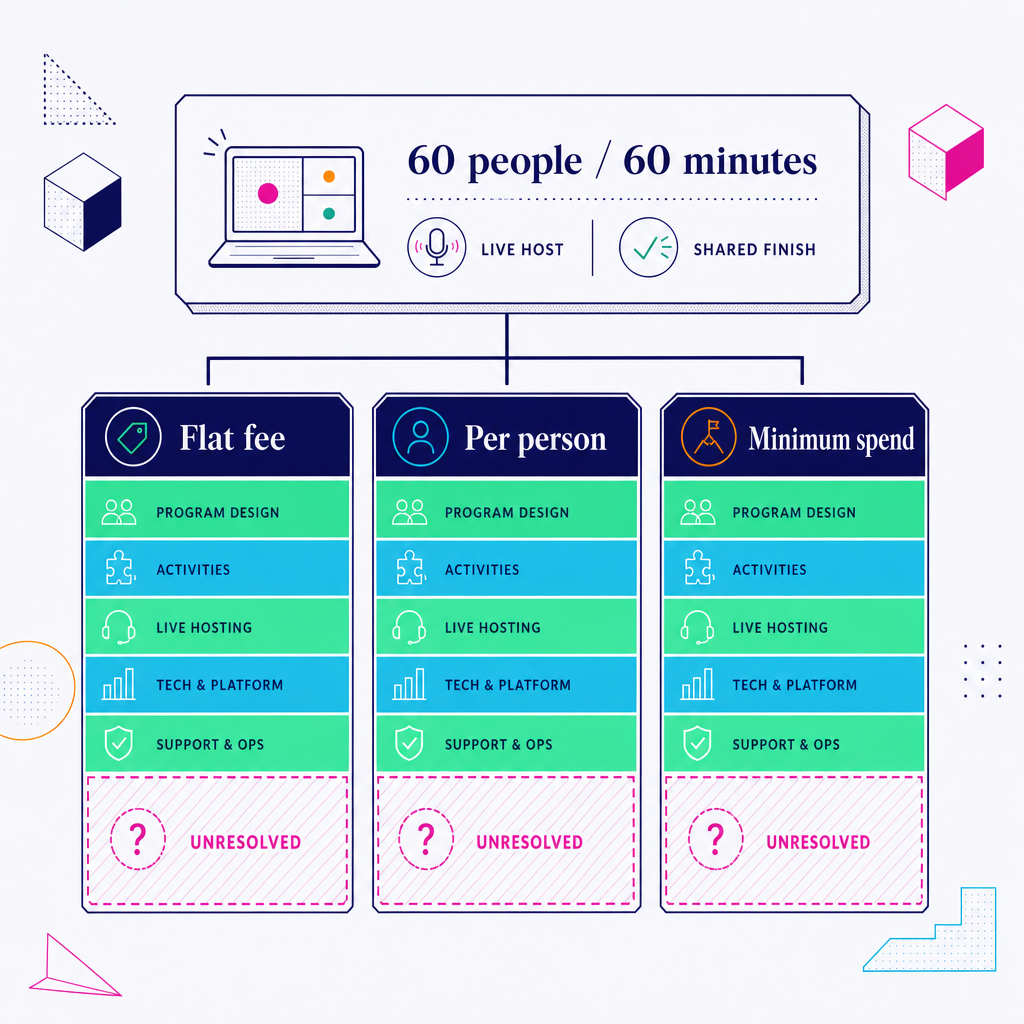
Hold one event brief steady
Use this common brief for the comparison:
- People and duration: 60 colleagues, one 60-minute Social Scavenger app-based virtual experience.
- Delivery: preparation, game access and live hosting, with kickoff, gameplay and the finish all inside the hour.
- Customization request: company branding, two company-specific questions and one consolidated content-review round.
- Agreed finish: the host shares selected team answers and announces winners.
- Outside the baseline: no separately delivered edited video or downloadable recap.
Keep the participant experience in view. In a sample round, a team opens a challenge in the web app. Two answers have supporters until someone notices a detail everyone else missed. The Tech Captain submits the shared response, and the team continues. You are buying that shared hour—not merely access to questions.
Social Scavenger’s virtual events include producer planning and live hosting. Most virtual games run in a mobile or desktop browser, with one Tech Captain signing in per team; app-based does not mean everyone must download an app. Team Trivia provides a concrete reference: a recommended 60-minute booking, web-based team challenges, standings between rounds and a shared media-and-winners finish.
A completed price comparison for 60 colleagues
Every price, inclusion, minimum and attendance cap below is an illustrative assumption—not a Social Scavenger rate, supplier quote or market-price estimate. All amounts are USD. Each model reaches the same brief after its listed additions. In Model C, only the base event charge counts toward the minimum; customization sits outside it.
| Comparison item | A: Flat fee | B: Per person | C: Minimum spend |
|---|---|---|---|
| Assumed base pricing | $1,800 for up to 75 people | $22 per billable person | $18 per billable person; $1,500 base minimum |
| Preparation, game access and live kickoff/gameplay | Included | Included | Included |
| Base calculation for 60 | $1,800 | 60 × $22 = $1,320 | Greater of $1,080 (60 × $18) or $1,500 = $1,500 |
| Branding, two company questions and requested review round | Included | Add $240 | Add $300 |
| Same hosted finish within the hour | Included | Add $180 | Included |
| Known pre-tax service subtotal | $1,800 | $1,740 | $1,800 |
| Effective known cost per planned attendee | $30 | $29 | $30 |
| Separately delivered recap | Not requested; excluded | Not requested; excluded | Not requested; excluded |
| Taxes and any mandatory invoice/payment charges | Unresolved | Unresolved | Unresolved |
| Final payable total | Not yet established | Not yet established | Not yet established |
Read the table in two passes. First, check that every column buys the same scope. Then compare the known subtotals.
Model C’s USD 18 headline becomes USD 30 per planned attendee after the minimum and customization. Model B has the lowest known subtotal at 60, but its advantage is only USD 60—not a confirmed saving while mandatory charges remain unresolved.
The reusable arithmetic is:
- Flat fee: base fee plus separately charged required scope.
- Per person: rate × billable headcount, plus separately charged required scope.
- Minimum spend: the greater of the eligible usage charge or the minimum, plus required charges outside that minimum.
The minimum is a floor here, not another fee added on top of the full per-person charge. Check what qualifies toward it in the actual quote. Likewise, Model B’s separately priced finish is part of the same 60 minutes—not extra event time.
Then change attendance—not the experience
Now increase the group from 60 to 72. Assume the increase is accepted before the applicable attendance cutoff, 72 becomes the billable count, and neither staffing nor scope needs to change.
- A stays at USD 1,800. The group remains within its assumed 75-person cap.
- B becomes USD 2,004: 72 × USD 22 + USD 240 + USD 180. The 12 additional people add USD 264.
- C stays at USD 1,800: 72 × USD 18 = USD 1,296, still below the USD 1,500 minimum. Add USD 300 for customization.
| Pricing model | At 60 | At 72 | Change |
|---|---|---|---|
| A: Flat fee | $1,800 | $1,800 | $0 |
| B: Per person | $1,740 | $2,004 | +$264 |
| C: Minimum spend | $1,800 | $1,800 | $0 |
The lowest known subtotal changes. B leads at 60; A and C are lower at 72. Their effective known costs at 72 are USD 25, approximately USD 27.83 and USD 25 per planned attendee, respectively. Taxes and mandatory charges remain unresolved.
That is the useful trade-off: a flat fee or minimum can absorb some additional attendance, while a per-person model responds directly to each accepted billable person. Neither structure wins at every headcount.
What if only 48 attend?
If a reduction is accepted and the billable count becomes 48, B falls to 48 × USD 22 + USD 240 + USD 180 = USD 1,476. A and C remain USD 1,800 under the same assumptions.
But if 60 remains the billable count and only 48 people join, do not recalculate the invoice using 48. An attendance reduction and a billing reduction are different things. The cutoff, no-show and substitution terms determine what happens.
Resolve what the arithmetic cannot settle
Mark each commercial item as included, separately priced, excluded by choice or unresolved. An omitted charge is unresolved—not automatically zero. Keep optional extras outside the baseline. If an advance payment is credited against the event total, show it in the payment schedule rather than counting the same cost twice.
Define the billable count and its deadline
Registered attendance is who signed up. Actual attendance is who joined. Billable attendance is the quantity the quote says you pay for. A booked or guaranteed count may remain billable even when fewer people attend; team app sign-ins are another measure entirely.
Ask whether the charging unit is participants, teams or something else. Record the final-count deadline and time zone, rules for increases and reductions, no-shows and substitutions, and any capacity or staffing threshold. Do not infer purchased seats from how many people operate the game.
Compare currencies without disguising uncertainty
Label the invoice currency explicitly as USD or CAD. For a cross-currency comparison, retain the original quoted amount and record the comparison currency, rate source and rate date using finance’s agreed convention.
For example, converting a USD quote into CAD means multiplying by the agreed CAD-per-USD rate. Keep conversion and payment charges separate. The Bank of Canada’s reference exchange rates are indicative, not guaranteed settlement rates. A budget conversion does not establish the amount your payment method will ultimately charge.
Name the customization—and distinguish two kinds of finish
A line saying “customized” is not enough. Name the branding, two company questions and requested review round, along with content and approval deadlines. Ask what additional revisions or late changes would cost. Social Scavenger’s customization options vary by game, so the agreed deliverables matter more than the label.
Carry any required participation arrangements into every version of your actual brief, with delivery and any cost implications agreed rather than assumed.
The live finish happens inside the purchased hour. A downloadable results file, collection of submissions or edited recap is a separate requested deliverable—not something to infer from a live reveal. If you want one, ask whether it is available, specify its contents, format, delivery date and access period, and add its confirmed price consistently.
Do not quietly drop the shared finish to make one column cheaper. That changes the event instead of clarifying its cost.
Send this clarification email before approving the quote
Use this to resolve the open amounts without reopening the event-design decision.
Subject: Please confirm scope and totals — 60-person virtual event
Hi [name],
Please confirm an itemized quote for 60 colleagues on [date/time/time zone]: one 60-minute app-based virtual event, including kickoff, live delivery and the agreed shared finish. Our customization request is company branding, two company questions and one consolidated review round.
Please provide totals for 60 and 72 billable participants in the invoice currency, identifying included services, minimums, taxes, mandatory fees and unresolved amounts. Flag any capacity or staffing change at 72.
What determines the billable count? Please confirm the attendance cutoff and time zone, reductions, no-shows, substitutions and additional-person charges, plus content and approval deadlines and extra-revision fees.
Please describe the live finish. We have not included a separately delivered recap; if available, price that option separately with its contents, format, delivery date and access period.
Please also confirm quote validity, payment timing and cancellation or rescheduling terms.
Thanks, [name]